Transfected Stable Cell Lines
Reliable | High-Performance | Wide Rage
Precision reporter, kinase, immune receptor, biosimilar, Cas9, and knockout stable cell lines for diverse applications.


Cat. No. : CSC-RO0177 Host Cell : U2OS
Size : >1x10⁶ cells/vial Validation : T7 Endonuclease I assay
| Cat. No. | CSC-RO0177 |
| Description | U2OS-Cas9 cell line is engineered to stably overexpress Cas9 nuclease. The Cas9 nuclease in U2OS-Cas9 cell line has been functionally validated using T7 Endonuclease I assay. In combination with separately transfected sgRNAs, U2OS-Cas9 cell line can be used to efficiently generate targeted genomic modifications including gene knockout, gene knockin, gene mutagenesis, gene tagging etc. It is also an ideal cell line model for sgRNA screening and validation, either individually or in pools. |
| Introduction | Clustered regularly interspaced palindromic repeats (CRISPR)/Cas9 is a gene-editing technology that contains two essential components: a guide RNA (gRNA) to match a target gene, and the Cas9 (CRISPR-associated protein 9) endonuclease which causes a double-stranded DNA break, allowing modifications to the genome via nonhomologous end joining (NHEJ) or homology-directed repair (HDR). |
| Product Type | Cas9 overexpression stable cell line |
| Background | The Cas9 Stable Cell Line in U2OS cells is another resource for CRISPR-Cas9-mediated gene editing. U2OS, a cell line derived from human osteosarcoma, is chosen for its high transfection efficiency and its ability to support the expression of Cas9 and guide RNAs. This cell line is particularly useful for studying the effects of gene editing on cell growth, differentiation, and the response to various stimuli. It also serves as a platform for the development of gene therapies and for the generation of cell lines with specific genetic modifications, which can be used for functional studies and drug discovery. |
| Target Gene | Cas9 |
| Host Cell | U2OS |
| Host Cell Species | Homo sapiens (Human) |
| Applications |
1) CRISPR genome editing, such as gene knockout (KO), gene knockin (KI), gene mutagenesis, gene tagging etc. 2) High-throughput sgRNA screening and validation |
| Size | One vial of frozen cells, typically >1x10⁶ cells/vial |
| Validation | T7 Endonuclease I assay |
| Quality Control |
1) T7E1 assay 2) Mycoplasma detection |
| Storage | Liquid nitrogen |
| Shipping | Dry ice |
| Revival | Rapidly thaw cells in a 37°C water bath. Transfer contents into a tube containing pre-warmed media. Centrifuge cells and seed into a 25 cm2 flask containing pre-warmed media. |
| Mycoplasma | Negative |
| Format | One frozen vial containing millions of cells |
| Storage | Liquid nitrogen |
| Safety Considerations |
The following safety precautions should be observed. 1. Use pipette aids to prevent ingestion and keep aerosols down to a minimum. 2. No eating, drinking or smoking while handling the stable line. 3. Wash hands after handling the stable line and before leaving the lab. 4. Decontaminate work surface with disinfectant or 70% ethanol before and after working with stable cells. 5. All waste should be considered hazardous. 6. Dispose of all liquid waste after each experiment and treat with bleach. |
| Ship | Dry ice |
| Target Gene | Cas9 |
DNA double-strand breaks (DSBs) are the most severe type of DNA damage, causing chromosomal translocations, genomic instability, and cell death. The researchers created the CDDR (CRISPR-Cas9-based Dual-fluorescent DSB Repair) assay to precisely detect and quantify DSB repair outcomes in mammalian cells. CDDR can discriminate between high-fidelity (HF), error-prone non-homologous end-joining (NHEJ), and homology-directed repair (HDR) by inserting one or two DSBs into an intrachromosomal fluorescent reporter with Cas9 and sgRNAs. CDDR demonstrated that HF-NHEJ is dependent on DNA Ligase IV, XRCC4, and XLF and that deleting these genes promotes HDR and error-prone end-joining. The deletion of the ATM kinase boosted HF-NHEJ and decreased HDR, demonstrating CDDR's value in researching DSB repair mechanisms.
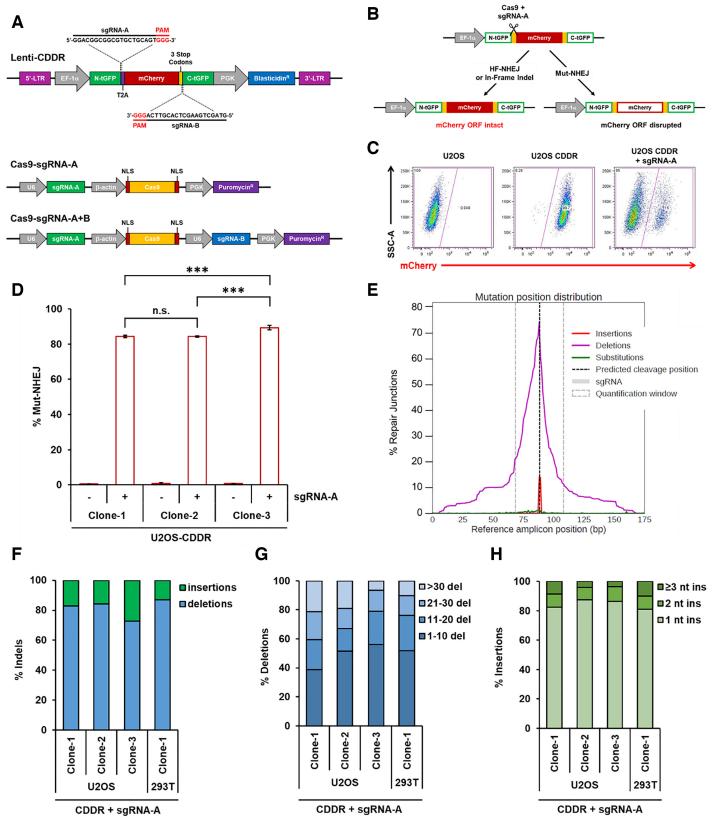 Figure 1. Using the CDDR reporter assay, the researchers identify and assess DSB repair. Cas9-sgRNA-expressing plasmid transfections in U2OS-CDDR cells are followed by FACS analysis to determine Mut-NHEJ repair efficiency. (Eki R, et al., 2023)
Enhance your genome editing research with Creative Biogene's Cas9 Stable Cell Line-U2OS. Our stable cell line offers reliable and consistent Cas9 expression, ensuring efficient genome editing without the variability associated with transient transfection. By utilizing this advanced tool, researchers can streamline the generation of U2OS-CDDR cells with precise deletions in DNA repair genes, accelerating studies on DNA double-strand break repair mechanisms. Experience enhanced efficiency, reproducibility, and cost-effectiveness in your experiments with Creative Biogene's Cas9 Stable Cell Line-U2OS, your partner in cutting-edge genetic research.
The Cas9 Stable Cell Line-U2OS is an osteosarcoma cell line that has been genetically modified to express the Cas9 enzyme. This cell line is particularly useful for studying the genetic basis of bone diseases and for developing gene therapies.
(1)Bone Disease Research:
The U2OS Cas9 Stable Cell Line enables researchers to investigate the genetic factors that contribute to bone diseases such as osteoporosis and osteosarcoma. By using CRISPR-Cas9 to manipulate specific genes, scientists can explore their roles in bone formation, mineralization, and homeostasis.
(2)Gene Therapy Development:
The Cas9 expression in U2OS cells allows for the exploration of gene therapy strategies for bone disorders. Researchers can test the efficacy of gene-editing approaches to correct genetic defects or to modify genes that influence bone health, potentially leading to new therapeutic interventions.
(3)Cancer Biology and Treatment Resistance:
As an osteosarcoma cell line, U2OS is also used to study the biology of cancer and the mechanisms of treatment resistance. The Cas9 system can be employed to target genes that confer resistance to chemotherapy or radiation therapy, providing insights into how to overcome these challenges and improve cancer treatment outcomes.
A: The cell line can be utilized to perform CRISPR-Cas9-mediated gene editing to study the function of genes implicated in osteosarcoma. By knocking out or modifying these genes, researchers can determine their roles in tumor growth, survival, and metastasis, leading to potential therapeutic targets.
A: By using CRISPR-Cas9 to target genes associated with drug resistance, the cell line can help researchers understand how these genes contribute to osteosarcoma cells' ability to evade chemotherapy and develop strategies to overcome resistance.
A: The cell line can be used to model the genetic changes found in osteosarcoma and test the efficacy of gene therapy strategies, such as introducing corrected or therapeutic genes into the cells. This can provide valuable information on the feasibility and effectiveness of gene therapy for osteosarcoma.
A: The cell line can be employed to study the genes and signaling pathways that contribute to the colonization of bones by osteosarcoma cells and the formation of bone metastases. This can lead to the identification of novel targets for preventing or treating bone metastasis in osteosarcoma patients.
A: By performing CRISPR-Cas9 screens and functional studies in the cell line, researchers can identify genetic vulnerabilities specific to osteosarcoma subtypes. This information can be used to develop targeted therapies that are tailored to the genetic profile of individual tumors, potentially improving treatment outcomes.
If your question is not addressed through these resources, you can fill out the online form below and we will answer your question as soon as possible.
The Cas9 Stable Cell Line - U2OS enables precise genetic modifications due to the stable integration and constant expression of the Cas9 protein. This precision is essential for creating accurate disease models and investigating gene function, ensuring that changes in the genome are exact and reflect intended edits.
Since Cas9 is already present and stably expressed, we using the Cas9 Stable Cell Line - U2OS can bypass the initial steps of introducing and establishing Cas9 expression systems. This efficiency streamlines the workflow, significantly reducing the time from experimental design to execution.
The controlled expression of Cas9 in the Cas9 Stable Cell Line - U2OS minimizes background genetic activity that could complicate results. This reduction is crucial for ensuring that experimental outcomes are due to the intended CRISPR edits and not to nonspecific Cas9 activity.
With its robust genetic editing capability, the Cas9 Stable Cell Line - U2OS is an excellent tool for screening potential therapeutic interventions at the genetic level. We can test the effects of gene modulation on disease phenotypes, aiding in the development of gene-based therapies and understanding the genetic basis of disease.
Write a review of your use of Biogene products and services in your research. Your review can help your fellow researchers make informed purchasing decisions.
Copyright © 2026 Creative Biogene. All rights reserved.