Transfected Stable Cell Lines
Reliable | High-Performance | Wide Rage
Precision reporter, kinase, immune receptor, biosimilar, Cas9, and knockout stable cell lines for diverse applications.


Cat. No. : CSC-RO0025 Host Cell : HEK293T
Size : >1x10⁶ cells/vial Validation : T7 Endonuclease I assay
| Cat. No. | CSC-RO0025 |
| Description | HEK293T-Cas9 cell line is engineered to stably overexpress Cas9 nuclease. The Cas9 nuclease in HEK293T-Cas9 cell line has been functionally validated using T7 Endonuclease I assay. In combination with separately transfected sgRNAs, HEK293T-Cas9 cell line can be used to efficiently generate targeted genomic modifications including gene knockout, gene knockin, gene mutagenesis, gene tagging etc. It is also an ideal cell line model for sgRNA screening and validation, either individually or in pools. |
| Introduction | Clustered regularly interspaced palindromic repeats (CRISPR)/Cas9 is a gene-editing technology that contains two essential components: a guide RNA (gRNA) to match a target gene, and the Cas9 (CRISPR-associated protein 9) endonuclease which causes a double-stranded DNA break, allowing modifications to the genome via nonhomologous end joining (NHEJ) or homology-directed repair (HDR). |
| Product Type | Cas9 overexpression stable cell line |
| Target Gene | Cas9 |
| Host Cell | HEK293T |
| Host Cell Species | Homo sapiens (Human) |
| Applications |
1) CRISPR genome editing, such as gene knockout (KO), gene knockin (KI), gene mutagenesis, gene tagging etc. 2) High-throughput sgRNA screening and validation |
| Size | One vial of frozen cells, typically >1x10⁶ cells/vial |
| Validation | T7 Endonuclease I assay |
| Quality Control |
1) T7E1 assay 2) Mycoplasma detection |
| Storage | Liquid nitrogen |
| Shipping | Dry ice |
| Revival | Rapidly thaw cells in a 37°C water bath. Transfer contents into a tube containing pre-warmed media. Centrifuge cells and seed into a 25 cm2 flask containing pre-warmed media. |
| Growth Properties | Cells are cultured as a monolayer at 37°C in a humidified atmosphere with 5% CO2. Split at 80-90% confluence, approximately 1:3-1:6. |
| Mycoplasma | Negative |
| Format | One frozen vial containing millions of cells |
| Storage | Liquid nitrogen |
| Safety Considerations |
The following safety precautions should be observed. 1. Use pipette aids to prevent ingestion and keep aerosols down to a minimum. 2. No eating, drinking or smoking while handling the stable line. 3. Wash hands after handling the stable line and before leaving the lab. 4. Decontaminate work surface with disinfectant or 70% ethanol before and after working with stable cells. 5. All waste should be considered hazardous. 6. Dispose of all liquid waste after each experiment and treat with bleach. |
| Ship | Dry ice |
| Target Gene | Cas9 |
HEK293T is a highly versatile human embryonic kidney cell line that stably expresses the SV40 large T antigen, making it one of the most widely used tools in biomedical research due to its excellent transfectability and robust protein expression. The Cas9 Stable Cell Line - HEK293T takes this workhorse cell line a step further by constitutively expressing the Streptococcus pyogenes Cas9 nuclease, eliminating the need for transient transfection or viral delivery of the Cas9 component in CRISPR experiments. These cells are generated through lentiviral transduction followed by antibiotic selection, resulting in a homogeneous population that maintains stable Cas9 expression over many passages. Researchers can directly introduce single guide RNAs (sgRNAs) via standard transfection methods and immediately achieve efficient gene editing without the variability and extra steps associated with co-delivering Cas9 and sgRNA simultaneously.
This cell line is particularly well suited for high-throughput functional genomics screens, where consistent Cas9 expression across all experimental conditions is critical for reproducibility. It is also widely used for generating knockout cell pools or clonal lines to study gene function, identify drug targets, and validate candidate genes involved in disease pathways. The constitutive Cas9 expression streamlines workflows for both loss-of-function and gain-of-function studies, especially when combined with sgRNA libraries or donor templates for homology-directed repair. Beyond basic research, the Cas9 HEK293T stable line supports applications in synthetic biology, viral production, and protein engineering, where reliable and efficient genome editing can significantly accelerate experimental timelines.
Especially in leukemia, characteristic fusion genes created by translocation following a chromosomal break are frequently seen in cancer. To disrupt the BCR-ABL fusion gene, the researchers investigate CRISPR-Cas9/dual-sgRNA targeting of the BCR and cABL introns. Changes in BCR-ABL expression in CML cells are achieved using lentiviruses expressing Cas9-GFP/dual-BA-sgRNA. The effects, which include cell proliferation, clonogenicity, apoptosis, and downstream signaling, are assessed at the genomic and protein levels. Validated in CML mice models and patient-derived cells, effective disruption results in BCR-ABL tyrosine kinase pathway blockage, decreasing cell proliferation and eliciting apoptosis.
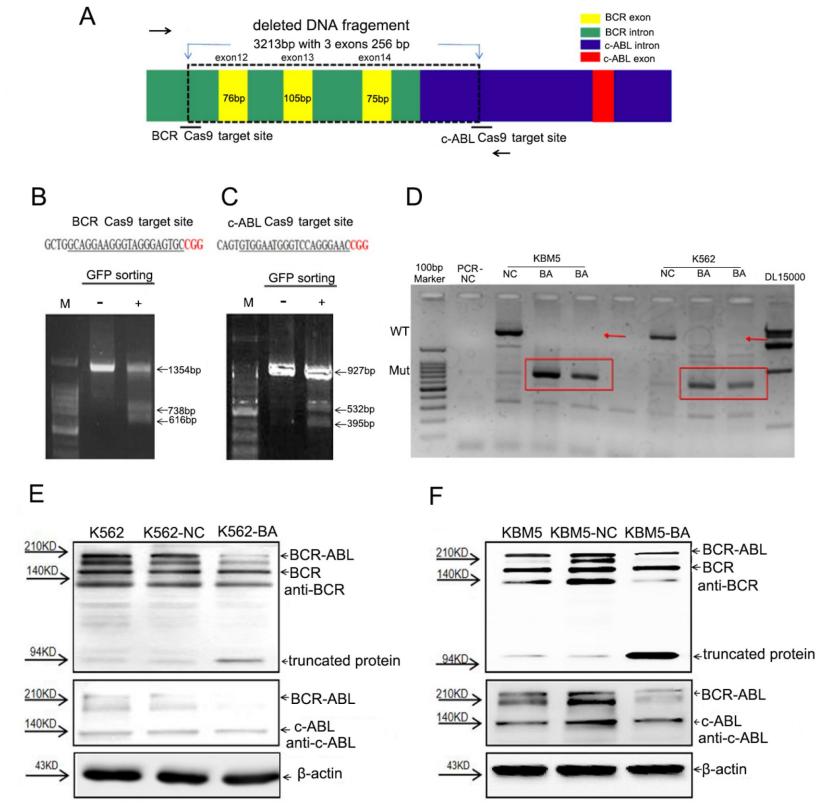 Figure 1. The researchers used Cas9-GFP/dual-BA-sgRNA to break the BCR-ABL fusion gene in CML cells. Dual sgRNAs targeted the BCR and cABL introns, respectively. The Cas9, GFP, and sgRNA co-expression vector was transfected into K562 cells. GFP+ cells were sorted for the targeted disruption efficiency assay, which confirmed genomic disruption with PCR and lowered BCR-ABL fusion protein levels with western blot analysis. The control empty vector Cas9 was co-transfected into HEK293T cells along with auxiliary plasmids pSPAX2 and pMD2G to generate the virus, serving as the negative control virus (NC). (Zeng J, et al., 2024)
If your question is not addressed through these resources, you can fill out the online form below and we will answer your question as soon as possible.
The HEK293T cell line has a high ability to express exogenous genes, so stable expression of Cas9 protein in it can achieve efficient gene knockout and insertion. So during the experiment, it is possible to edit specific genes more quickly and accurately.
Write a review of your use of Biogene products and services in your research. Your review can help your fellow researchers make informed purchasing decisions.
Copyright © 2026 Creative Biogene. All rights reserved.