Transfected Stable Cell Lines
Reliable | High-Performance | Wide Rage
Precision reporter, kinase, immune receptor, biosimilar, Cas9, and knockout stable cell lines for diverse applications.


Cat. No. : CSC-RO0171 Host Cell : CFPAC-1
Size : >1x10⁶ cells/vial Validation : T7 Endonuclease I assay
| Cat. No. | CSC-RO0171 |
| Description | CFPAC-1-Cas9 cell line is engineered to stably overexpress Cas9 nuclease. The Cas9 nuclease in CFPAC-1-Cas9 cell line has been functionally validated using T7 Endonuclease I assay. In combination with separately transfected sgRNAs, CFPAC-1-Cas9 cell line can be used to efficiently generate targeted genomic modifications including gene knockout, gene knockin, gene mutagenesis, gene tagging etc. It is also an ideal cell line model for sgRNA screening and validation, either individually or in pools. |
| Introduction | Clustered regularly interspaced palindromic repeats (CRISPR)/Cas9 is a gene-editing technology that contains two essential components: a guide RNA (gRNA) to match a target gene, and the Cas9 (CRISPR-associated protein 9) endonuclease which causes a double-stranded DNA break, allowing modifications to the genome via nonhomologous end joining (NHEJ) or homology-directed repair (HDR). |
| Product Type | Cas9 overexpression stable cell line |
| Target Gene | Cas9 |
| Host Cell | CFPAC-1 |
| Host Cell Species | Homo sapiens (Human) |
| Applications |
1) CRISPR genome editing, such as gene knockout (KO), gene knockin (KI), gene mutagenesis, gene tagging etc. 2) High-throughput sgRNA screening and validation |
| Size | One vial of frozen cells, typically >1x10⁶ cells/vial |
| Validation | T7 Endonuclease I assay |
| Quality Control |
1) T7E1 assay 2) Mycoplasma detection |
| Storage | Liquid nitrogen |
| Shipping | Dry ice |
| Revival | Rapidly thaw cells in a 37°C water bath. Transfer contents into a tube containing pre-warmed media. Centrifuge cells and seed into a 25 cm2 flask containing pre-warmed media. |
| Mycoplasma | Negative |
| Format | One frozen vial containing millions of cells |
| Storage | Liquid nitrogen |
| Safety Considerations |
The following safety precautions should be observed. 1. Use pipette aids to prevent ingestion and keep aerosols down to a minimum. 2. No eating, drinking or smoking while handling the stable line. 3. Wash hands after handling the stable line and before leaving the lab. 4. Decontaminate work surface with disinfectant or 70% ethanol before and after working with stable cells. 5. All waste should be considered hazardous. 6. Dispose of all liquid waste after each experiment and treat with bleach. |
| Ship | Dry ice |
| Target Gene | Cas9 |
With its aggressive aggressiveness and resistance to standard treatments, pancreatic ductal adenocarcinoma (PDAC) offers a major obstacle in oncology. Researchers looking for creative therapies are investigating the possibilities of Stimulator of Interferon Genes (STING) agonists, meant to trigger the natural immune response against malignancies. The researchers looked at possible combo treatments that boost the impact of STING agonists such as systemically given molecule diABZI. After screening 430 kinase inhibitors, they found MEK inhibitors as main synergistic agents driving tumor cell death. Especially in CFPAC-1 cells, which showed strong STING expression levels, this synergy was most evident. The research showed that MEK inhibition not only enhanced the capacity of STING agonism to trigger type I interferon-dependent cell death but also produced notable in vivo tumor regression. This study emphasizes the need of knowing the processes behind STING-mediated effects, therefore enabling more successful combination treatments for PDAC.
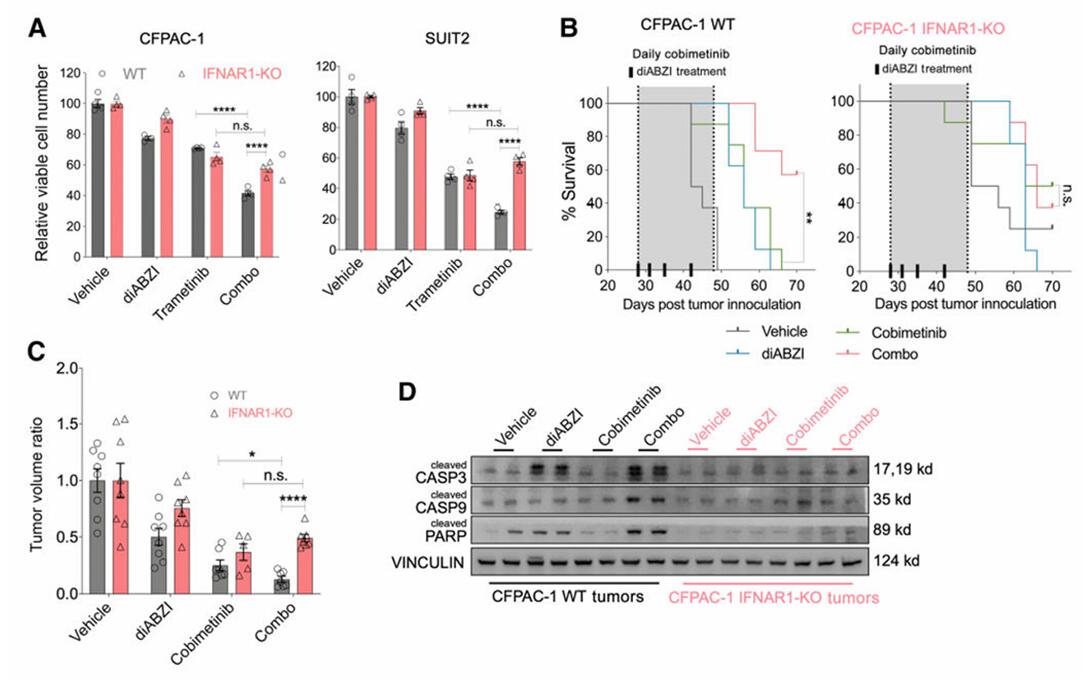 Figure 1. The researchers utilized CFPAC-1 and SUIT2 cells with CRISPR/Cas9-mediated deletion of the IFNα receptor 1 (IFNAR1-KO) to assess the role of Type I IFN signaling in the synergy between STING activation and MEK inhibition. (Ghukasyan R, et al., 2023)
Creative Biogene's Cas9 Stable Cell Line - CFPAC-1 offers a robust platform for such investigations. The design incorporates multiple guide RNAs targeting key genes related to STING signaling and tumor biology. Following electroporation, the CFPAC-1 cells demonstrated high knockout efficiency, allowing for precise gene editing and functional studies.
If your question is not addressed through these resources, you can fill out the online form below and we will answer your question as soon as possible.
Write a review of your use of Biogene products and services in your research. Your review can help your fellow researchers make informed purchasing decisions.
Copyright © 2026 Creative Biogene. All rights reserved.