Transfected Stable Cell Lines
Reliable | High-Performance | Wide Rage
Precision reporter, kinase, immune receptor, biosimilar, Cas9, and knockout stable cell lines for diverse applications.


Cat. No. : CSC-RO0028 Host Cell : MCF7
Size : >1x10⁶ cells/vial Validation : T7 Endonuclease I assay
| Cat. No. | CSC-RO0028 |
| Description | MCF-7-Cas9 cell line is engineered to stably overexpress Cas9 nuclease. The Cas9 nuclease in MCF-7-Cas9 cell line has been functionally validated using T7 Endonuclease I assay. In combination with separately transfected sgRNAs, MCF-7-Cas9 cell line can be used to efficiently generate targeted genomic modifications including gene knockout, gene knockin, gene mutagenesis, gene tagging etc. It is also an ideal cell line model for sgRNA screening and validation, either individually or in pools. |
| Introduction | Clustered regularly interspaced palindromic repeats (CRISPR)/Cas9 is a gene-editing technology that contains two essential components: a guide RNA (gRNA) to match a target gene, and the Cas9 (CRISPR-associated protein 9) endonuclease which causes a double-stranded DNA break, allowing modifications to the genome via nonhomologous end joining (NHEJ) or homology-directed repair (HDR). |
| Product Type | Cas9 overexpression stable cell line |
| Target Gene | Cas9 |
| Host Cell | MCF7 |
| Host Cell Species | Homo sapiens (Human) |
| Applications |
1) CRISPR genome editing, such as gene knockout (KO), gene knockin (KI), gene mutagenesis, gene tagging etc. 2) High-throughput sgRNA screening and validation |
| Size | One vial of frozen cells, typically >1x10⁶ cells/vial |
| Validation | T7 Endonuclease I assay |
| Quality Control |
1) T7E1 assay 2) Mycoplasma detection |
| Storage | Liquid nitrogen |
| Shipping | Dry ice |
| Revival | Rapidly thaw cells in a 37°C water bath. Transfer contents into a tube containing pre-warmed media. Centrifuge cells and seed into a 25 cm2 flask containing pre-warmed media. |
| Mycoplasma | Negative |
| Format | One frozen vial containing millions of cells |
| Storage | Liquid nitrogen |
| Safety Considerations |
The following safety precautions should be observed. 1. Use pipette aids to prevent ingestion and keep aerosols down to a minimum. 2. No eating, drinking or smoking while handling the stable line. 3. Wash hands after handling the stable line and before leaving the lab. 4. Decontaminate work surface with disinfectant or 70% ethanol before and after working with stable cells. 5. All waste should be considered hazardous. 6. Dispose of all liquid waste after each experiment and treat with bleach. |
| Ship | Dry ice |
| Target Gene | Cas9 |
The MCF-7 cell line is one of the most widely used models in breast cancer research, originally established in 1973 from the pleural effusion of a 69-year-old female patient with metastatic invasive breast carcinoma. Derived at the Michigan Cancer Foundation, MCF-7 was the first hormone-responsive breast cancer cell line ever developed, and it remains a standard tool for studying estrogen receptor signaling, endocrine therapy responses, and luminal-type breast cancer biology. The Cas9 Stable Cell Line - MCF-7 is a genetically engineered derivative of the parental MCF-7 line, engineered to stably express the CRISPR-associated protein 9 (Cas9) nuclease from Streptococcus pyogenes. The cells retain the key genetic characteristics of the original MCF-7 line, including the homozygous deletion of CDKN2A, heterozygous GATA3 frameshift mutation, and the well-known PIK3CA E545K activating mutation, making them directly comparable to the parental line for most experimental contexts.
This cell line is primarily used for CRISPR-based functional genomics applications, enabling researchers to perform efficient gene knockout experiments by simply delivering synthetic guide RNAs (sgRNAs) via transient transfection or viral transduction, without the need for co-delivering Cas9. Common applications include large-scale pooled CRISPR screens to identify genes essential for cancer cell proliferation, drug resistance, or metastasis; targeted single-gene knockout studies to validate potential therapeutic targets in breast cancer; and combinatorial CRISPR approaches for exploring synthetic lethal interactions. The Cas9 Stable MCF-7 line is also valuable for studying gene regulation through CRISPR activation or interference (CRISPRa/i) when paired with appropriate dCas9-fusion constructs. Because the Cas9 expression is stable and uniform across the population, experimental variability is reduced compared to transient Cas9 delivery methods, and the system is compatible with high-throughput screening formats. Researchers also use these cells to investigate mechanisms of endocrine resistance, DNA damage repair pathways, and tumor microenvironment interactions, leveraging the well-characterized MCF-7 background to connect genetic perturbations with phenotypic outcomes in a breast cancer context.
Over 70% of breast tumors express the nuclear receptor (NR) estrogen receptor-α (ERα) and rely heavily on its signaling for tumor growth. The researchers used genome-scale CRISPR-Cas9 screens in MCF-7 breast cancer cells under SI-12 pharmacological pressure to find gene targets that enhance BC cell cytotoxicity. A parallel screen utilizing the ER inhibitor fulvestrant revealed insights into SRC-3 and ERα inhibitory actions. Validating findings from MCF-7 screenings in different cancer cell lines increased our understanding of SRC-3's role in carcinogenesis beyond breast cancer.
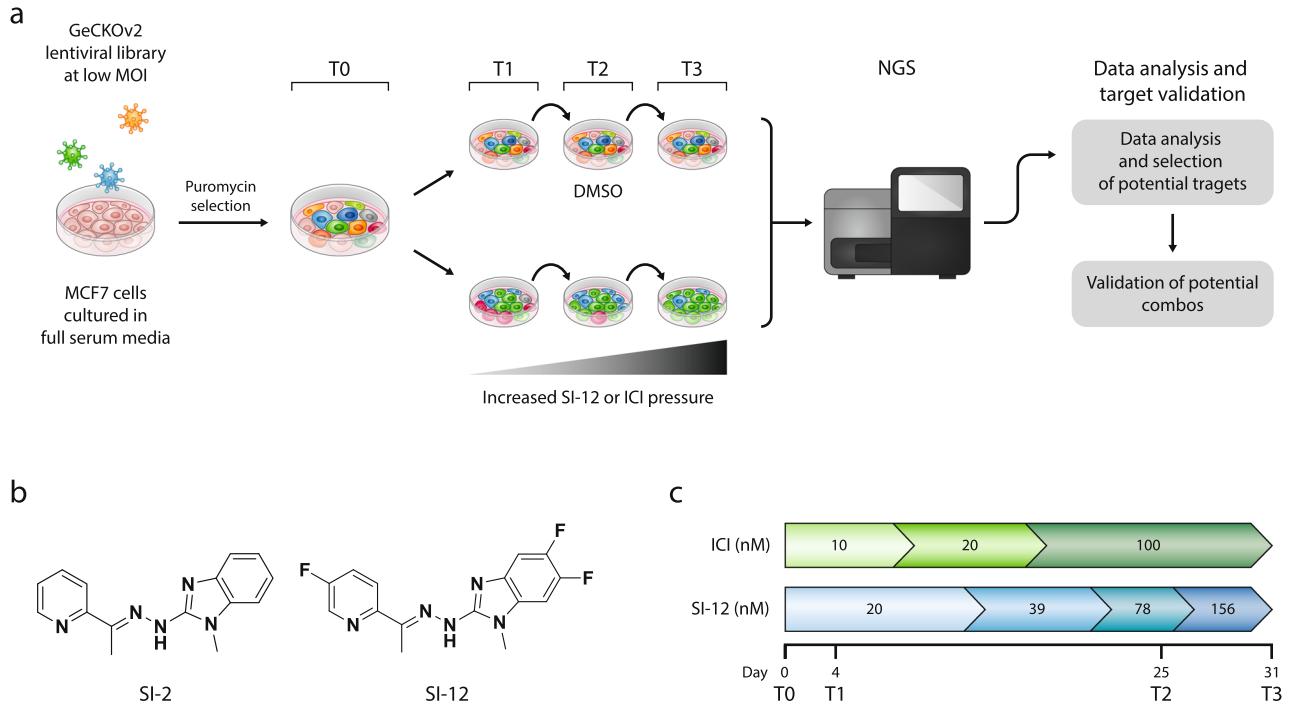 Figure 1. In MCF-7 cells, the researchers performed a pooled CRISPR/Cas9 screening with the genome-wide single vector library GeCKOv2. Cells were treated to greater pharmacological pressure using SRC-3 inhibitors SI-12 or ICI to find genetic vulnerabilities for medication combinations. gDNA was obtained at three time periods, amplified by PCR in bar-coded areas, and evaluated by NGS. (Gilad Y, et al., 2021)
Unlock the potential of genome-scale CRISPR-Cas9 screens with Creative Biogene's Cas9 Stable Cell Line-MCF-7. Engineered for stability and efficiency, this cell line ensures reliable Cas9 expression, empowering precise gene editing under pharmacological pressures like SI-12. Conduct parallel screens with confidence using inhibitors such as fulvestrant to explore SRC-3 and ERα inhibition synergies. Validate hits across diverse cancer cell lines effortlessly, gaining deeper insights into cancer biology and therapeutic targets.
A: The application of the Cas9 Stable Cell Line-MCF-7 in gene editing research includes providing a platform for studying Cas9-mediated gene knockouts, knockins, and genome editing. This cell line allows scientists to perform efficient gene editing without the need to transfect Cas9 and sgRNA for each experiment.
A: To ensure the stability of the CRISPR/Cas9 system in Cas9 Stable Cell Line-MCF-7 during long-term culture, regular genomic sequencing is necessary. This ensures that no undesired mutations or losses have occurred in the CRISPR/Cas9 system, while also monitoring the expression levels of the gene editing tools to ensure their editing efficiency and precision.
A: The uniqueness of the Cas9 Stable Cell Line-MCF-7 lies in its combination of the efficient gene editing capabilities of the CRISPR/Cas9 system with the breast cancer-specific genetic environment of the MCF-7 cells. This combination not only allows researchers to perform precise genetic manipulations within a cellular context closely related to breast cancer pathogenesis but also enables the exploration of the impact of specific gene edits on the biological behavior of breast cancer cells, providing a powerful platform for understanding cancer biology.
A: The creation of Cas9 Stable Cell Line-MCF-7 significantly advances the development of breast cancer drug screening and therapeutic research. By performing gene editing in this cell line, researchers can rapidly generate cell models with specific gene knockouts or knock-ins to evaluate the targeting effects and mechanisms of drugs. Moreover, this cell line also provides a valuable tool for studying drug resistance mechanisms in breast cancer, aiding in the development of more effective treatment strategies.
A: The main advantage of the Cas9 Stable Cell Line-MCF-7 lies in its stable integration of the CRISPR/Cas9 system, making it an ideal choice for genome editing experiments. Particularly in the field of breast cancer research, this cell line enables efficient gene knockout, knock-in, or modification, accelerating the understanding of breast cancer pathogenesis and the discovery of new therapeutic targets.
If your question is not addressed through these resources, you can fill out the online form below and we will answer your question as soon as possible.
The Cas9 Stable Cell Line-MCF-7 has stably integrated Cas9 protein, making it an immediately available gene editing tool. This means researchers can directly proceed with CRISPR/Cas9-mediated gene editing experiments without the need for additional time and steps to express Cas9, thus accelerating the experimental process.
Due to the stable expression of Cas9 protein in the Cas9 Stable Cell Line-MCF-7, this cell line offers efficient gene knockout capabilities. This provides researchers with a powerful tool for exploring gene function and pathological mechanisms in cancer cell models.
In the Cas9 Stable Cell Line-MCF-7, the stable expression of Cas9 reduces background noise caused by overexpression or nonspecific binding, thereby increasing the accuracy and reliability of experiments.
By using the Cas9 Stable Cell Line-MCF-7, researchers can skip the steps of constructing and transfecting a Cas9 expression vector, moving directly into the gene editing phase of experiments. This simplifies the experimental workflow, making research more efficient.
Write a review of your use of Biogene products and services in your research. Your review can help your fellow researchers make informed purchasing decisions.
Copyright © 2026 Creative Biogene. All rights reserved.