Transfected Stable Cell Lines
Reliable | High-Performance | Wide Rage
Precision reporter, kinase, immune receptor, biosimilar, Cas9, and knockout stable cell lines for diverse applications.


Cat. No. : CSC-RO0181 Host Cell : SH-SY5Y
Size : >1x10⁶ cells/vial Validation : T7 Endonuclease I assay
| Cat. No. | CSC-RO0181 |
| Description | SH-SY5Y-Cas9 cell line is engineered to stably overexpress Cas9 nuclease. The Cas9 nuclease in SH-SY5Y-Cas9 cell line has been functionally validated using T7 Endonuclease I assay. In combination with separately transfected sgRNAs, SH-SY5Y-Cas9 cell line can be used to efficiently generate targeted genomic modifications including gene knockout, gene knockin, gene mutagenesis, gene tagging etc. It is also an ideal cell line model for sgRNA screening and validation, either individually or in pools. |
| Introduction | Clustered regularly interspaced palindromic repeats (CRISPR)/Cas9 is a gene-editing technology that contains two essential components: a guide RNA (gRNA) to match a target gene, and the Cas9 (CRISPR-associated protein 9) endonuclease which causes a double-stranded DNA break, allowing modifications to the genome via nonhomologous end joining (NHEJ) or homology-directed repair (HDR). |
| Product Type | Cas9 overexpression stable cell line |
| Target Gene | Cas9 |
| Host Cell | SH-SY5Y |
| Host Cell Species | Homo sapiens (Human) |
| Applications |
1) CRISPR genome editing, such as gene knockout (KO), gene knockin (KI), gene mutagenesis, gene tagging etc. 2) High-throughput sgRNA screening and validation |
| Size | One vial of frozen cells, typically >1x10⁶ cells/vial |
| Validation | T7 Endonuclease I assay |
| Quality Control |
1) T7E1 assay 2) Mycoplasma detection |
| Storage | Liquid nitrogen |
| Shipping | Dry ice |
| Revival | Rapidly thaw cells in a 37°C water bath. Transfer contents into a tube containing pre-warmed media. Centrifuge cells and seed into a 25 cm2 flask containing pre-warmed media. |
| Mycoplasma | Negative |
| Format | One frozen vial containing millions of cells |
| Storage | Liquid nitrogen |
| Safety Considerations |
The following safety precautions should be observed. 1. Use pipette aids to prevent ingestion and keep aerosols down to a minimum. 2. No eating, drinking or smoking while handling the stable line. 3. Wash hands after handling the stable line and before leaving the lab. 4. Decontaminate work surface with disinfectant or 70% ethanol before and after working with stable cells. 5. All waste should be considered hazardous. 6. Dispose of all liquid waste after each experiment and treat with bleach. |
| Ship | Dry ice |
| Target Gene | Cas9 |
Cas9 is a groundbreaking molecular tool in the field of genetic engineering, discovered in 2012 by Jennifer Doudna and Emmanuelle Charpentier. It is an RNA-guided DNA endonuclease derived from the bacterial CRISPR-Cas immune system. Cas9 enables precise genome editing by inducing double-strand breaks at specific target sites within the DNA sequence. This technology revolutionized gene editing due to its simplicity, efficiency, and versatility.
SY5Y, a human neuroblastoma cell line, has been extensively employed in neuroscience research. Originally established in 1970, SY5Y cells exhibit characteristics reminiscent of immature sympathetic neurons, making them a valuable model for studying neuronal development, differentiation, and neurodegenerative diseases.
The development of Cas9 Stable Cell Line-SH-SY5Y integrates the power of Cas9 technology with the utility of the SY5Y cell line. This engineered cell line, established in recent years, facilitates efficient and precise genome editing within the SY5Y cellular context. It serves as a potent tool for elucidating the molecular mechanisms underlying neurodevelopmental processes and neurological disorders, offering unprecedented opportunities for advancing our understanding of neuronal biology.
Researchers employed CRISPR‐Cas9 technology to investigate the impact of a rare mutation (rs144662445) in the AKAP9 gene, linked to Alzheimer's disease (AD) in African Americans (AA), on tau pathology and the tau interactome in SH‐SY5Y P301L neuron‐like cells. The mutation notably elevated phosphorylated tau levels, particularly at Ser396/Ser404. Additionally, analysis of the tau interactome revealed dysregulation of RNA translation, localization, and oxidative activity, resembling findings from human AD brain samples. Functional assays confirmed reduced protein synthesis and increased oxidative stress, mimicking AD pathology. These findings highlight the role of AKAP9 in AD pathogenesis.
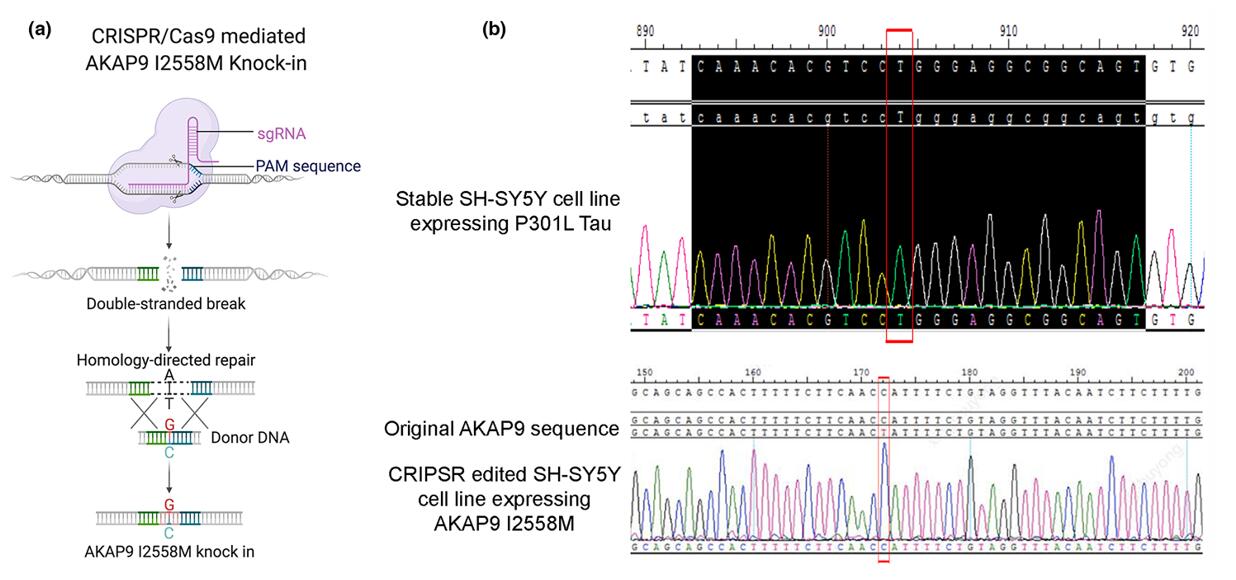 Figure 1. CRISPR-mediated AKAP9 I2558M mutation knock-in was performed in SH-SY5Y P301L cells, followed by neuronal differentiation. Mutation generation was confirmed by Sanger sequencing. (You Y, et al., 2022)
Creative Biogene's Cas9 Stable Cell Line-SH-SY5Y expedites similar studies, eliminating the need for gene editing steps. This pre-engineered cell line directly investigates gene mutation effects on tau pathology and the tau interactome, saving time and costs while accelerating disease mechanism understanding.
1. Gene Editing: Utilize CRISPR/Cas9 system to knockout or knock-in specific genes in SH-SY5Y cells, enabling the study of gene function in neurobiology.
2. Disease Modeling: Introduce disease-associated mutations into SH-SY5Y cells to mimic pathological conditions such as Parkinson's or Alzheimer's disease, facilitating mechanistic studies.
3. Drug Screening: Employ CRISPR/Cas9-modified SH-SY5Y cells to screen potential therapeutics for neurodegenerative disorders, enhancing drug discovery efforts.
4. Signal Transduction Studies: Investigate signaling pathways involved in neuronal development and function by manipulating target genes in SH-SY5Y cells.
5. Neurotoxicity Assessment: Assess the impact of environmental toxins or pharmaceutical compounds on neuronal viability and function using genetically engineered SH-SY5Y cell lines.
A: BXPC-3 cells were likely selected for their relevance to pancreatic cancer research and their ability to be efficiently edited using CRISPR/Cas9 technology, enabling studies on gene function and therapeutic targets.
A: Efficiency and specificity were likely assessed through methods such as genomic sequencing, functional assays measuring indel formation, or reporter assays targeting known Cas9 cleavage sites.
A: Characterization may involve analysis of knockout or knock-in efficiency, off-target effects, changes in cellular proliferation, migration, or response to chemotherapeutic agents upon genetic manipulation.
A: Quality control likely included confirmation of Cas9 expression levels, validation of its editing efficiency and specificity, assessment of off-target effects, and validation of phenotypic changes associated with genetic manipulation.
A: Comparative analysis with other pancreatic cancer models or patient-derived samples helps elucidate the functional significance of targeted genes, identify novel therapeutic targets, and guide personalized treatment strategies for pancreatic cancer patients.
If your question is not addressed through these resources, you can fill out the online form below and we will answer your question as soon as possible.
Outstanding versatility! The Cas9 Stable Cell Line in SH-SY5Y cells has been a versatile tool in our neurobiology research. Its stable expression of Cas9 has enabled precise and efficient genome editing, facilitating the investigation of neuronal gene function and regulation.
Reliable and efficient! The stable expression of Cas9 in SH-SY5Y cells has allowed us to perform targeted gene editing with high specificity and efficacy. Its consistent Cas9 expression has ensured reliable and reproducible results across experiments, enhancing the robustness of our findings.
Simplifying our studies! With the Cas9 Stable Cell Line, we've been able to explore the molecular mechanisms underlying neurological disorders with confidence. Its stable expression of Cas9 has simplified experimental workflows and accelerated the pace of our research.
Impressive performance! The Cas9 Stable Cell Line has consistently exhibited efficient Cas9-mediated genome editing, surpassing our expectations. Its stable expression has been pivotal in uncovering the genetic basis of neurodevelopmental and neurodegenerative diseases.
A valuable asset in neuroscience! The Cas9 Stable Cell Line has revolutionized our approach to studying brain function and dysfunction. Its stable expression of Cas9 has provided a reliable platform for dissecting the complexities of neuronal biology and identifying potential therapeutic targets.
Write a review of your use of Biogene products and services in your research. Your review can help your fellow researchers make informed purchasing decisions.
Copyright © 2026 Creative Biogene. All rights reserved.