Transfected Stable Cell Lines
Reliable | High-Performance | Wide Rage
Precision reporter, kinase, immune receptor, biosimilar, Cas9, and knockout stable cell lines for diverse applications.


Cat. No. : CSC-RO0223 Host Cell : 786-O
Size : >1x10⁶ cells/vial Validation : T7 Endonuclease I assay
| Cat. No. | CSC-RO0223 |
| Description | 786-O-Cas9 cell line is engineered to stably overexpress Cas9 nuclease. The Cas9 nuclease in 786-O-Cas9 cell line has been functionally validated using T7 Endonuclease I assay. In combination with separately transfected sgRNAs, 786-O-Cas9 cell line can be used to efficiently generate targeted genomic modifications including gene knockout, gene knockin, gene mutagenesis, gene tagging etc. It is also an ideal cell line model for sgRNA screening and validation, either individually or in pools. |
| Introduction | Clustered regularly interspaced palindromic repeats (CRISPR)/Cas9 is a gene-editing technology that contains two essential components: a guide RNA (gRNA) to match a target gene, and the Cas9 (CRISPR-associated protein 9) endonuclease which causes a double-stranded DNA break, allowing modifications to the genome via nonhomologous end joining (NHEJ) or homology-directed repair (HDR). |
| Product Type | Cas9 overexpression stable cell line |
| Background | The 786-O cell line, derived from human renal carcinoma, is another host for stable Cas9 expression. This cell line provides an additional model for CRISPR-Cas9 gene editing, offering a different genetic background for studying the effects of genetic modifications. With stable Cas9 expression, the 786-O cell line can be used to investigate the role of specific genes in cancer biology, to develop targeted therapies, and to create isogenic cell lines for comparative studies. This cell line is also valuable for studying the mechanisms of CRISPR-Cas9-mediated gene editing and for optimizing gene editing protocols. |
| Target Gene | Cas9 |
| Host Cell | 786-O |
| Host Cell Species | Homo sapiens (Human) |
| Applications |
1) CRISPR genome editing, such as gene knockout (KO), gene knockin (KI), gene mutagenesis, gene tagging etc. 2) High-throughput sgRNA screening and validation |
| Size | One vial of frozen cells, typically >1x10⁶ cells/vial |
| Validation | T7 Endonuclease I assay |
| Quality Control |
1) T7E1 assay 2) Mycoplasma detection |
| Storage | Liquid nitrogen |
| Shipping | Dry ice |
| Revival | Rapidly thaw cells in a 37°C water bath. Transfer contents into a tube containing pre-warmed media. Centrifuge cells and seed into a 25 cm2 flask containing pre-warmed media. |
| Mycoplasma | Negative |
| Format | One frozen vial containing millions of cells |
| Storage | Liquid nitrogen |
| Safety Considerations |
The following safety precautions should be observed. 1. Use pipette aids to prevent ingestion and keep aerosols down to a minimum. 2. No eating, drinking or smoking while handling the stable line. 3. Wash hands after handling the stable line and before leaving the lab. 4. Decontaminate work surface with disinfectant or 70% ethanol before and after working with stable cells. 5. All waste should be considered hazardous. 6. Dispose of all liquid waste after each experiment and treat with bleach. |
| Ship | Dry ice |
| Target Gene | Cas9 |
Transcription factors play a critical role in regulating gene expression programs that determine cell identity and disease states. In Renal Cell Carcinoma (RCC), the Core Regulatory Circuitry (CRC) analysis identified PAX8 as a potential oncogene. Functional genomic screens confirmed that silencing PAX8 impairs RCC cell proliferation, while epigenomic studies revealed that PAX8 binds to active enhancer elements that control genes involved in metabolic pathways. One such gene, Ceruloplasmin (CP), was highlighted for its role in PAX8-mediated gene regulation. PAX8's recruitment of histone acetylation at enhancers impacts CP expression, which correlates with RCC cell sensitivity to PAX8 silencing. These findings underscore PAX8 as both an oncogene and a potential biomarker for RCC. The researchers used the 786-O Cas9 stable cell line to explore the effects of PAX8 silencing, utilizing lentiviral constructs for precise genetic modifications.
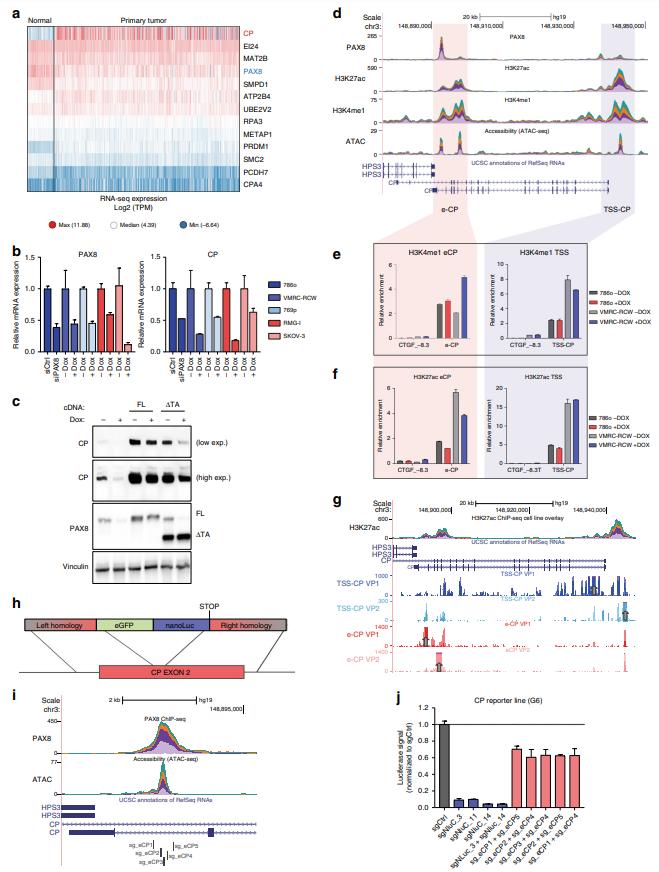 Figure 1. The researchers employed a combination of RNA-seq, qPCR, and Western blot analysis to study PAX8 regulation of CP in RCC cells. Using the 786-O Cas9 stable cell line, they silenced PAX8 and examined its impact on CP expression and enhancer activity, validating results with ChIP-qPCR and luciferase assays. (Bleu M, et al., 2019)
Creative Biogene offers similar Cas9 stable cell line products, like the 786-O Cas9 line, enabling targeted gene editing for cancer research, including studies on gene function, drug resistance, and biomarker discovery.
The Cas9 Stable Cell Line - 786-O is a renal cell carcinoma cell line engineered to stably express the Cas9 endonuclease, an enzyme that enables precise gene editing. This cell line is particularly beneficial for research in gene function, cancer biology, and the development of targeted therapies for kidney cancer.
(1)Functional Genomics of Renal Cancer:
The 786-O Cas9 Stable Cell Line is used to investigate the genomic landscape of renal cell carcinoma. Researchers can perform genome-wide screens to identify genes that drive cancer growth or are involved in drug resistance, leading to a better understanding of renal cancer biology and the identification of novel therapeutic targets.
(2)Personalized Medicine Approaches:
By utilizing the Cas9 system to edit the genome of 786-O cells, researchers can model specific genetic mutations found in patient tumors. This allows for the testing of personalized treatment strategies, potentially leading to more effective and tailored therapies for kidney cancer patients.
(3)Drug Screening and Development:
The Cas9 expression in 786-O cells facilitates the screening of compounds for their potential to inhibit kidney cancer cell growth or induce apoptosis. By knocking out or modifying genes associated with cancer progression, researchers can assess the efficacy of potential drugs and identify new molecular targets for cancer therapy.
A: The cell line allows for precise gene editing using CRISPR-Cas9 technology to knock out genes of interest and study their functions, particularly those implicated in renal carcinoma pathogenesis.
A: Yes, targeted gene editing can be performed to knock out or introduce mutations in genes associated with drug metabolism or efflux, thereby creating models to study drug resistance mechanisms.
A: HDR efficiency can be variable; it can be measured by co-delivering a donor template with a fluorescent or antibiotic resistance marker and quantifying the cells exhibiting the repair via flow cytometry or drug selection.
A: The Cas9 expression is typically stable over many cell passages, facilitating multiple rounds of gene editing for extended studies; however, regular validation is recommended to ensure consistent expression levels.
A: It is crucial to perform comprehensive off-target analysis using next-generation sequencing or similar methods and to confirm the specificity of sgRNAs to minimize off-target modifications.
If your question is not addressed through these resources, you can fill out the online form below and we will answer your question as soon as possible.
With Cas9 pre-integrated, the Cas9 Stable Cell Line - 786-O streamlines the CRISPR gene editing process, reducing the need for additional transfection steps and thus minimizing experimental setup time. This efficiency is crucial for fast-tracking studies and generating results more rapidly.
Stable expression of Cas9 in the Cas9 Stable Cell Line - 786-O ensures that each cell within the population has a similar editing capability, significantly enhancing the reproducibility of genetic experiments. This consistent performance is vital for studies requiring high reliability and precision.
The controlled expression of Cas9 in the Cas9 Stable Cell Line - 786-O minimizes Cas9-induced cytotoxicity, which can arise from overexpression in transient systems. This aspect ensures healthier cell cultures and more reliable experimental outcomes.
The stable and reliable presence of Cas9 in the Cas9 Stable Cell Line - 786-O supports multiplex gene editing, where multiple genes are targeted simultaneously. This capability is particularly useful in complex genetic studies where interactions between multiple genes are investigated.
Write a review of your use of Biogene products and services in your research. Your review can help your fellow researchers make informed purchasing decisions.
Copyright © 2026 Creative Biogene. All rights reserved.