Transfected Stable Cell Lines
Reliable | High-Performance | Wide Rage
Precision reporter, kinase, immune receptor, biosimilar, Cas9, and knockout stable cell lines for diverse applications.


Cat. No. : CSC-RO0027 Host Cell : A549
Size : >1x10⁶ cells/vial Validation : T7 Endonuclease I assay
| Cat. No. | CSC-RO0027 |
| Description | A549-Cas9 cell line is engineered to stably overexpress Cas9 nuclease. The Cas9 nuclease in A549-Cas9 cell line has been functionally validated using T7 Endonuclease I assay. In combination with separately transfected sgRNAs, A549-Cas9 cell line can be used to efficiently generate targeted genomic modifications including gene knockout, gene knockin, gene mutagenesis, gene tagging etc. It is also an ideal cell line model for sgRNA screening and validation, either individually or in pools. |
| Introduction | Clustered regularly interspaced palindromic repeats (CRISPR)/Cas9 is a gene-editing technology that contains two essential components: a guide RNA (gRNA) to match a target gene, and the Cas9 (CRISPR-associated protein 9) endonuclease which causes a double-stranded DNA break, allowing modifications to the genome via nonhomologous end joining (NHEJ) or homology-directed repair (HDR). |
| Product Type | Cas9 overexpression stable cell line |
| Target Gene | Cas9 |
| Host Cell | A549 |
| Host Cell Species | Homo sapiens (Human) |
| Applications |
1) CRISPR genome editing, such as gene knockout (KO), gene knockin (KI), gene mutagenesis, gene tagging etc. 2) High-throughput sgRNA screening and validation |
| Size | One vial of frozen cells, typically >1x10⁶ cells/vial |
| Validation | T7 Endonuclease I assay |
| Quality Control |
1) T7E1 assay 2) Mycoplasma detection |
| Storage | Liquid nitrogen |
| Shipping | Dry ice |
| Revival | Rapidly thaw cells in a 37°C water bath. Transfer contents into a tube containing pre-warmed media. Centrifuge cells and seed into a 25 cm2 flask containing pre-warmed media. |
| Mycoplasma | Negative |
| Format | One frozen vial containing millions of cells |
| Storage | Liquid nitrogen |
| Safety Considerations |
The following safety precautions should be observed. 1. Use pipette aids to prevent ingestion and keep aerosols down to a minimum. 2. No eating, drinking or smoking while handling the stable line. 3. Wash hands after handling the stable line and before leaving the lab. 4. Decontaminate work surface with disinfectant or 70% ethanol before and after working with stable cells. 5. All waste should be considered hazardous. 6. Dispose of all liquid waste after each experiment and treat with bleach. |
| Ship | Dry ice |
| Target Gene | Cas9 |
The Cas9 Stable Cell Line in A549 cells is a powerful tool for genetic engineering, as it allows for the precise editing of the genome. Cas9, derived from the Streptococcus pyogenes bacteria, is a CRISPR-associated protein that acts as a molecular scissor, enabling the addition, deletion, or modification of DNA sequences at specific loci.
The A549 cell line, derived from human lung carcinoma, is known for its high transfection efficiency and its ability to form tumors when implanted into immunodeficient mice. With stable Cas9 expression, this cell line facilitates the study of gene function, the development of gene therapies, and the investigation of cancer-related pathways. It is also valuable for creating isogenic cell lines for use in drug screening and disease modeling.
Influenza A virus (IAV) is one of the most prevalent pathogens responsible for human respiratory infections. The researchers utilized human isogenic p53 wild-type and p53null A549 cells generated from CRISPR/Cas9 technology. They found that influenza A virus infection (strain A/Puerto Rico/8/1934 H1N1) significantly reduces viral propagation in p53null cells. Genome-wide microarray analysis revealed that p53 regulates the expression of interferon-inducible genes, notably downregulating IFITM1, IFITM2, and IFITM3. Knockdown of IFITMs increased virus infectivity in p53null cells, whereas IFITM overexpression inhibited virus entry in A549 cells. Interestingly, p53's influence on IFITMs was independent of its transcriptional activity, as shown by the Δ40p53 isoform's similar effects. These findings highlight a novel role of p53 in enhancing influenza virus infectivity by inhibiting IFITMs, uncovering a mechanism for viral propagation regulation via p53 activation.
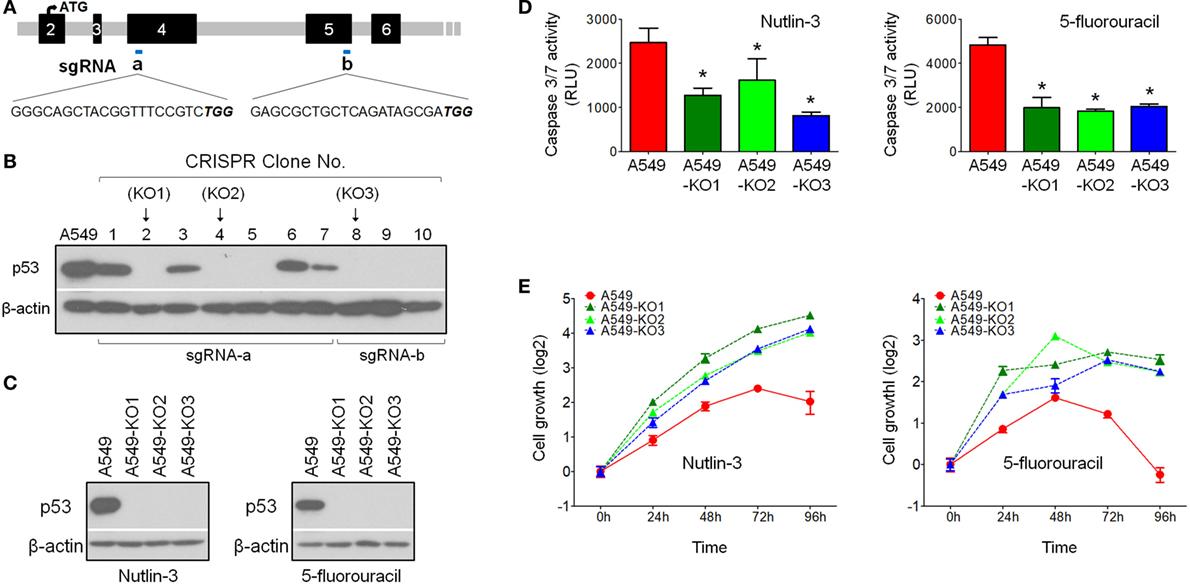 Figure 1. The researchers used CRISPR/Cas9 technology to create p53null A549 cells. They created sgRNA targeting p53WT, validated p53 protein loss in cell clones using Western blots, and found lower caspase activity and resistance to Nutlin-3 and 5-fluorouracil-induced cell death in p53null clones. (Wang B, et al., 2018)
Creative Biogene's Cas9 stable cell line-A549 provides a convenient and efficient solution for your experiments. This cell line already stably expresses the Cas9 protein and is ideal for gene editing using CRISPR/Cas9 technology. You can directly use these cell lines to generate p53 knockout (p53null) variant cells by targeting the p53 gene. This operation eliminates the step of independently establishing homologous p53 wild-type and p53null cell lines, saving time and effort. Once established, these cell lines can be infected with the influenza A virus to study the effects of p53 knockout on viral propagation and its interaction with IFITMs. Choose Creative Biogene's Cas9 stable cell line-A549 to ensure the consistency and reliability of your experimental results when studying the role of p53 in influenza virus infection.
The Cas9 Stable Cell Line-A549 is a lung carcinoma cell line that stably expresses the Cas9 endonuclease, an enzyme that enables precise gene editing. This cell line is widely used in genetic engineering and molecular biology research.
(1)Gene Editing and Functional Studies:
The A549 Cas9 Stable Cell Line facilitates the generation of genetically modified cells for functional studies. Researchers can use CRISPR-Cas9 technology to introduce specific genetic modifications, such as knockouts or knockins, to study the function of particular genes in lung cancer development and progression.
(2) Cancer Therapy Development:
This cell line is also valuable for testing the efficacy of novel cancer therapies. By expressing Cas9, A549 cells can be genetically engineered to target and disrupt specific genes that contribute to cancer growth or drug resistance, providing a platform for the development of targeted therapies.
(3)Modeling Genetic Diseases:
The Cas9 Stable Cell Line can be used to model genetic diseases related to lung function or respiratory disorders. By introducing disease-associated genetic variants into the A549 cells, researchers can study the cellular and molecular effects of these mutations, leading to a better understanding of disease mechanisms and potential therapeutic targets.
A: The cell line can be used to perform CRISPR-Cas9 genome editing experiments to investigate the function of specific genes in lung cancer development and progression. By knocking out or modifying these genes, researchers can identify potential targets for lung cancer therapy and understand their roles in tumor biology.
A: The cell line can be employed to study the molecular changes that facilitate lung cancer cell migration, invasion, and metastasis. By using CRISPR-Cas9 technology to manipulate genes involved in these processes, researchers can gain insights into the mechanisms driving lung cancer spread.
A: The cell line can be genetically modified using CRISPR-Cas9 to introduce patient-specific mutations, creating isogenic models that mimic the genetic landscape of individual lung cancers. This can help researchers study the impact of these mutations on cancer cell behavior and test personalized treatment strategies.
A: The cell line can be used in high-throughput screening assays to identify compounds that effectively target lung cancer cells with specific genetic alterations. This can accelerate the discovery of targeted therapies for lung cancer and improve the efficacy and specificity of treatment.
A: By manipulating genes that regulate the tumor microenvironment, such as those involved in immune cell infiltration and angiogenesis, the cell line can be used to study the complex interactions between cancer cells and their surrounding environment. This can provide insights into how the microenvironment influences lung cancer progression and treatment response.
If your question is not addressed through these resources, you can fill out the online form below and we will answer your question as soon as possible.
The Cas9 Stable Cell Line - A549 simplifies the CRISPR gene-editing process by pre-expressing Cas9, eliminating the need for transfection of the Cas9 component. This streamlining greatly enhances the efficiency of gene-editing workflows, allowing us to focus on guide RNA design and target gene study.
With the stable expression of Cas9, this cell line provides consistent gene-editing outcomes. The Cas9 Stable Cell Line - A549 ensures that the CRISPR-associated protein is uniformly available, leading to more reliable and reproducible editing results, which is crucial for high-precision genetic studies.
As A549 is a lung cancer cell line, the Cas9 Stable Cell Line - A549 is particularly effective for creating models of respiratory diseases. We can use this tool to explore gene functions in pulmonary conditions, aiding in the development of targeted therapies for lung cancer and other lung-related diseases.
The stable and controlled expression of Cas9 in the Cas9 Stable Cell Line - A549 reduces the potential for off-target effects, a common concern in transient transfection models. This feature helps maintain the integrity of the experiments and increases the accuracy of the gene-editing process.
Write a review of your use of Biogene products and services in your research. Your review can help your fellow researchers make informed purchasing decisions.
Copyright © 2026 Creative Biogene. All rights reserved.