Transfected Stable Cell Lines
Reliable | High-Performance | Wide Rage
Precision reporter, kinase, immune receptor, biosimilar, Cas9, and knockout stable cell lines for diverse applications.


Cat. No. : CSC-RO0026 Host Cell : HeLa
Size : >1x10⁶ cells/vial Validation : T7 Endonuclease I assay
| Cat. No. | CSC-RO0026 |
| Description | HeLa-Cas9 cell line is engineered to stably overexpress Cas9 nuclease. The Cas9 nuclease in HeLa-Cas9 cell line has been functionally validated using T7 Endonuclease I assay. In combination with separately transfected sgRNAs, HeLa-Cas9 cell line can be used to efficiently generate targeted genomic modifications including gene knockout, gene knockin, gene mutagenesis, gene tagging etc. It is also an ideal cell line model for sgRNA screening and validation, either individually or in pools. |
| Introduction | Clustered regularly interspaced palindromic repeats (CRISPR)/Cas9 is a gene-editing technology that contains two essential components: a guide RNA (gRNA) to match a target gene, and the Cas9 (CRISPR-associated protein 9) endonuclease which causes a double-stranded DNA break, allowing modifications to the genome via nonhomologous end joining (NHEJ) or homology-directed repair (HDR). |
| Product Type | Cas9 overexpression stable cell line |
| Target Gene | Cas9 |
| Host Cell | HeLa |
| Host Cell Species | Homo sapiens (Human) |
| Applications |
1) CRISPR genome editing, such as gene knockout (KO), gene knockin (KI), gene mutagenesis, gene tagging etc. 2) High-throughput sgRNA screening and validation |
| Size | One vial of frozen cells, typically >1x10⁶ cells/vial |
| Validation | T7 Endonuclease I assay |
| Quality Control |
1) T7E1 assay 2) Mycoplasma detection |
| Storage | Liquid nitrogen |
| Shipping | Dry ice |
| Revival | Rapidly thaw cells in a 37°C water bath. Transfer contents into a tube containing pre-warmed media. Centrifuge cells and seed into a 25 cm2 flask containing pre-warmed media. |
| Mycoplasma | Negative |
| Format | One frozen vial containing millions of cells |
| Storage | Liquid nitrogen |
| Safety Considerations |
The following safety precautions should be observed. 1. Use pipette aids to prevent ingestion and keep aerosols down to a minimum. 2. No eating, drinking or smoking while handling the stable line. 3. Wash hands after handling the stable line and before leaving the lab. 4. Decontaminate work surface with disinfectant or 70% ethanol before and after working with stable cells. 5. All waste should be considered hazardous. 6. Dispose of all liquid waste after each experiment and treat with bleach. |
| Ship | Dry ice |
| Target Gene | Cas9 |
The HeLa cell line is one of the oldest and most widely used human cell lines in biomedical research, originally derived from a cervical adenocarcinoma in 1951. Known for its robust growth, high transfection efficiency, and ability to propagate indefinitely in culture, HeLa has become a foundational tool for countless studies in cell biology, virology, and cancer research. The Cas9 Stable Cell Line - HeLa is a genetically engineered derivative that constitutively and stably expresses the Streptococcus pyogenes Cas9 endonuclease. This eliminates the need for transient Cas9 plasmid delivery or protein transfection in each experiment, allowing researchers to perform CRISPR-based genome editing simply by introducing single guide RNAs (sgRNAs) into the cells. The stable expression of Cas9 ensures consistent cutting efficiency across experiments and reduces experimental variability, making it a reliable and convenient platform for gene editing studies.
This cell product is particularly well suited for loss-of-function screening, functional genomics, and validation of gene targets. By delivering sgRNAs targeting specific genes of interest, researchers can rapidly generate knockout cell populations or clonal lines to study gene function, drug resistance mechanisms, or disease pathways. The Cas9 Stable Cell Line - HeLa is also valuable for high-throughput CRISPR screens, where pooled sgRNA libraries are introduced to identify genes involved in specific biological processes or drug responses. Additionally, it can be used for studying host-pathogen interactions, as HeLa cells are permissive to many viral infections, and for investigating DNA repair pathways following Cas9-induced double-strand breaks. The stable nature of Cas9 expression further supports long-term experiments, including those requiring multiple rounds of editing or combinatorial gene perturbations. With its ease of use, reproducibility, and broad applicability, the Cas9 Stable Cell Line - HeLa serves as a versatile and efficient tool for both basic research and translational studies aimed at identifying novel therapeutic targets or understanding the molecular basis of human disease.
The researchers explored the mechanism of Tc toxin recognition and cellular intoxication, focusing on how specific glycan receptors, such as N-glycans and sulfated glycosaminoglycans (sGAGs), mediate the binding of different Tc toxins. The researchers performed two independent genome-wide CRISPR-Cas9 screens using HeLa cells to identify genes involved in toxin sensitivity. Their findings revealed that the knockout of N-glycan processing enzymes blocked TcdA1W14 toxicity, while sulfation in sGAGs was critical for the binding of TcdA2TT01. This work provides new insights into the host-specific interactions of Tc toxins, which could lead to more targeted biomedical applications. To perform these CRISPR screens, the researchers utilized HeLa cells stably expressing Cas9 (HeLa-Cas9), which were transduced with a lentiviral single guide RNA (sgRNA) library targeting over 19,000 human genes.
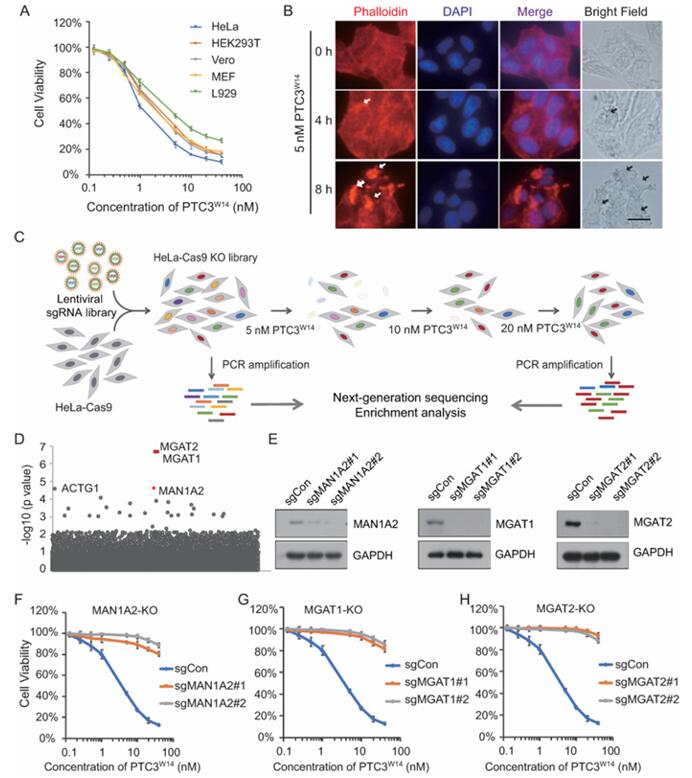 Figure 1. The researchers used HeLa-Cas9 cells to perform a genome-wide CRISPR-Cas9 screen, identifying genes involved in PTC3W14 toxin sensitivity. They treated these cells with various concentrations of PTC3W14 and assessed cell viability, actin polymerization, and membrane blebbing to identify critical host factors. (Song N, et al., 2021)
Creative Biogene's Cas9 Stable Cell Line - HeLa is ideal for similar genetic screening applications, offering a reliable platform for gene knockout studies and advanced toxin receptor research.
If your question is not addressed through these resources, you can fill out the online form below and we will answer your question as soon as possible.
Generating knockouts in our lab has never been easier since we switched to this Cas9-expressing HeLa line. We simply transfect our sgRNAs and consistently achieve over 80% editing efficiency. The cells are healthy, robust, and express Cas9 at high, stable levels.
Write a review of your use of Biogene products and services in your research. Your review can help your fellow researchers make informed purchasing decisions.
Copyright © 2026 Creative Biogene. All rights reserved.