Transfected Stable Cell Lines
Reliable | High-Performance | Wide Rage
Precision reporter, kinase, immune receptor, biosimilar, Cas9, and knockout stable cell lines for diverse applications.


Cat. No. : CSC-RT2779
Target Gene : DHFR Host Cell : CHO-K1
Size : >1x10⁶ cells/vial Validation : Sequencing
| Cat. No. | CSC-RT2779 |
| Description | This cell is a stable cell line with a homozygous knockout of DHFR using CRISPR/Cas9. |
| Target Gene | DHFR |
| Host Cell | CHO-K1 |
| Host Cell Species | Cricetulus griseus (Chinese hamster) |
| Size | 1 vial (>10^6 cell/vial) |
| Validation | Sequencing |
| Storage | Liquid Nitrogen |
| Shipping | Dry ice package |
| Revival | Rapidly thaw cells in a 37°C water bath. Transfer contents into a tube containing pre-warmed media. Centrifuge cells and seed into a 25 cm2 flask containing pre-warmed media. |
| Mycoplasma | Negative |
| Format | One frozen vial containing millions of cells |
| Storage | Liquid nitrogen |
| Safety Considerations |
The following safety precautions should be observed. 1. Use pipette aids to prevent ingestion and keep aerosols down to a minimum. 2. No eating, drinking or smoking while handling the stable line. 3. Wash hands after handling the stable line and before leaving the lab. 4. Decontaminate work surface with disinfectant or 70% ethanol before and after working with stable cells. 5. All waste should be considered hazardous. 6. Dispose of all liquid waste after each experiment and treat with bleach. |
| Ship | Dry ice |
In humans, dihydrofolate reductase (DHFR) is encoded by the DHFR gene located in the q14.1 region of chromosome 5. The DHFR enzyme catalyzes the reduction of dihydrofolate (DHF) to tetrahydrofolate (THF) using NADPH as an electron donor. This reaction is essential for the production of purines, thymidylate, and certain amino acids, all of which are required for cell proliferation and growth. Structurally, DHFR can exist in two different classes: the classical type found in bacterial and mammalian chromosomes and the type II enzyme found in certain plastids. The classical type of DHFR in mammals shows high similarity between species, but in bacteria, antibiotic pressure leads to different binding affinities for various inhibitors, resulting in multiple resistant strains.
Functionally, DHFR ensures a continuous supply of tetrahydrofolate, maintaining the balance of one-carbon transfer reactions within the cell. This balance is essential for the synthesis of nucleotides, and the lack of DHFR activity can lead to serious health problems such as megaloblastic anemia or pancytopenia. DHFR is also a target for several drugs. The well-known chemotherapy drug methotrexate inhibits mammalian DHFR to limit cell proliferation in cancer treatment. Similarly, trimethoprim targets bacterial DHFR to act as an antibiotic. However, resistance to these drugs can arise through mutations in the DHFR gene, necessitating continued research and development of new inhibitors.
Chinese hamster ovary (CHO) cell lines are the most widely used mammalian cell lines for large-scale production of therapeutic proteins, especially antibodies. Here, researchers investigated the effects of adenosine and its derivative cordycepin on the production of recombinant human monoclonal antibodies (adalimumab) in two commonly used Chinese hamster ovary (CHO) cell lines. The two cell lines have different gene amplification systems, namely CHO DHFR knockout (CHO-DHFR−) and GS-CHO knockout (GS-KO CHO) cells. The results showed that adenosine inhibited the cell growth rate of both CHO cell lines and increased the proportion of cells in the S phase of the cell cycle. In cultures without glucose feeding, adenosine could significantly increase the antibody titer and productivity of both CHO cell lines. However, in the presence of glucose feeding, adenosine did not increase the antibody titer in CHO-DHFR− cells, but prolonged the culture time and significantly increased the antibody titer in GS-KO CHO cells. Therefore, adenosine supplementation may be useful for medium- to large-scale batch production of antibodies in GS-KO CHO cells. In the case of the adenosine derivative cordycepin, CHO-DHFR- cells required approximately 10-fold higher cordycepin concentrations than GS-KO CHO cells to show changes in cell growth and cell cycle. In addition, cordycepin significantly increased antibody titers only in CHO-DHFR- cells cultured without the addition of glucose.
In terms of antibody titer and productivity (Figure 1), after the addition of adenosine, antibody titer (approximately 1.2-1.4-fold) and productivity (approximately 1.5-2.6-fold) were increased in all adenosine-treated groups compared to the control group. The greatest effect of adenosine supplementation was seen on day 2 of cell culture, with a significant increase in antibody titer and productivity compared to the control group.
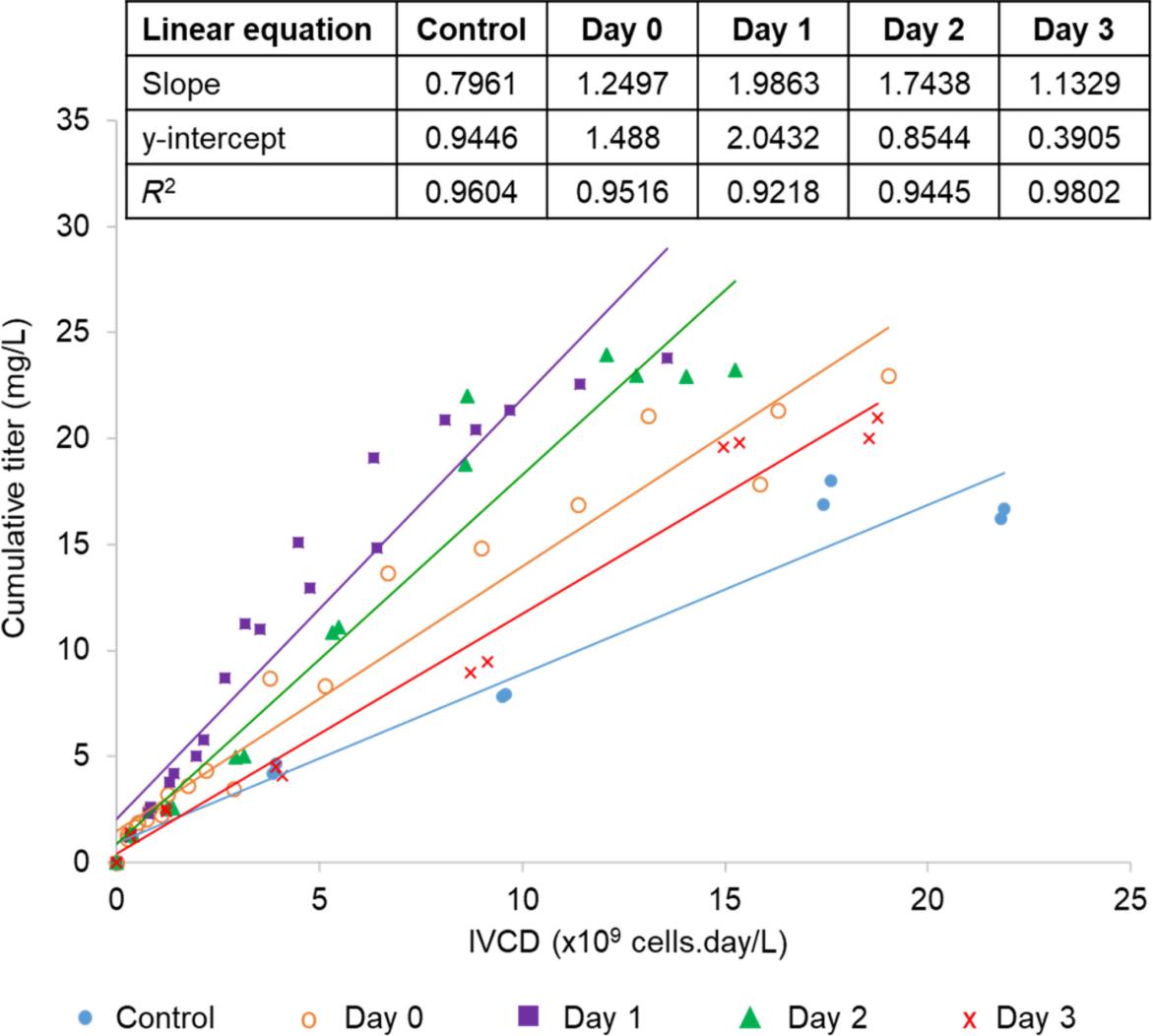 Figure 1. The relationship between integral viable cell density (IVCD) and cumulative antibody titer obtained from CHO DHFR knockout cells treated with 1 mM adenosine supplementation on different days. (Jarusintanakorn S, et al., 2024)
Applications of DHFR Knockout Cell Line-CHO K1
1. Antibody Production: The DHFR Knockout Cell Line-CHO K1 is widely used in the production of therapeutic antibodies. By utilizing the DHFR (dihydrofolate reductase) selection system, researchers can amplify the production of genes of interest, leading to high-yield antibody expression.
2. Protein Engineering: This cell line is instrumental in the engineering of proteins. Researchers can insert recombinant genes coding for desired proteins and use the DHFR selection mechanism to enhance protein expression levels.
3. Drug Screening and Development: The DHFR Knockout Cell Line-CHO K1 is used for high-throughput drug screening. It allows for the identification of potential drug candidates that can influence the DHFR pathway. By testing compounds on these cells, researchers can evaluate their efficacy and toxicity, providing critical insights during the drug development process.
4. Gene Function Study: Scientists leverage the DHFR Knockout Cell Line-CHO K1 to study gene function and regulation. By knocking out the DHFR gene, researchers can investigate the downstream effects and interactions of this genotype, contributing to a deeper understanding of cellular pathways and gene networks.
5. Vaccine Production: This cell line is also employed in the production of vaccines. The ability to amplify genes using the DHFR system enhances the yield of antigens required for vaccine formulation.
A: The knockout cell product is validated by PCR amplification and Sanger Sequencing to confirm the mutation at the genomic level. Please find the detailed mutation info in the datasheet.
A: Single clonal cell.
A: No. This knockout cell product is generated using the CRISPR/Cas9 system to induce small insertions or deletions (indels) resulting in frameshift mutations. Although these frameshift mutations typically disrupt the coding gene, there is a possibility that the non-functional transcript may still be transcribed. Consequently, this could potentially yield misleading results when analyzed by RT-qPCR.
A: The cell line should be stored in liquid nitrogen for long-term preservation.
A: For most cases, we often keep at least 2 clones with different frameshift mutations. Please feel free to contact us to check if there are additional available clones.
If your question is not addressed through these resources, you can fill out the online form below and we will answer your question as soon as possible.
I couldn't be more pleased with the DHFR Knockout Cell Line-CHO K1. It's an incredible tool for our gene editing projects.
The DHFR Knockout Cell Line-CHO K1 has exceeded our expectations in every way. The line maintained exceptional viability and growth characteristics throughout our experiments.
Write a review of your use of Biogene products and services in your research. Your review can help your fellow researchers make informed purchasing decisions.
Copyright © 2026 Creative Biogene. All rights reserved.