Animal Tissue & Cell RNA Purification Kits
RNA is an important molecule involved in protein coding, decoding, regulation and expression, carrying valuable
information about an organism's genetic blueprint. Understanding this blueprint allows us to delve into the function
of cellular machinery, leading to breakthroughs in fields ranging from evolutionary biology to disease prognosis. Due
to the fragility of RNA, it is easily degraded. Extracting intact RNA for accurate and reliable research results
becomes a challenge. The Animal Tissue and Cell RNA Purification Kit is an important solution that provides a robust,
simple and rapid method to isolate and purify RNA without compromising the integrity and quality of the RNA sample.
Creative Biogene's Animal Tissue & Cell RNA Purification Kit provides a rapid method for isolating and purifying
total RNA from all types of animal tissue and cell samples, including fibrous-rich tissues such as muscle and heart.
The kit isolates RNA from fresh or flash-frozen tissues, cells, as well as formalin-fixed paraffin-embedded (FFPE)
tissue samples. The kit purifies RNA of all sizes in the same fraction, from large mRNAs, lncRNAs to microRNAs
(miRNAs), without the need for phenol. Purified RNA is of the highest integrity and can be used in a variety of
downstream applications including real-time PCR, reverse transcription PCR, Northern blotting, RNase protection and
primer extension, and expression array assays.
- Rapid — complete procedure within 30 minutes of cell lysis
- Convenience — Ready-to-use RNA for any downstream application
- Isolate multiple RNA species — All RNA species, from large mRNA and ribosomal RNA to microRNA (miRNA) and small
interfering RNA (siRNA) can be isolated.
- Isolate and purify total RNA from various animal tissue samples, including difficult-to-extract fibrous tissues
such as heart and muscle
If you are unsure which assay and reagents are right for your application, please review our Animal Tissue & Cell RNA
Purification Kit specific product pages, or contact a member of our team for a recommendation.
Animal Tissue & Cell RNA Purification Kit List
Case Study
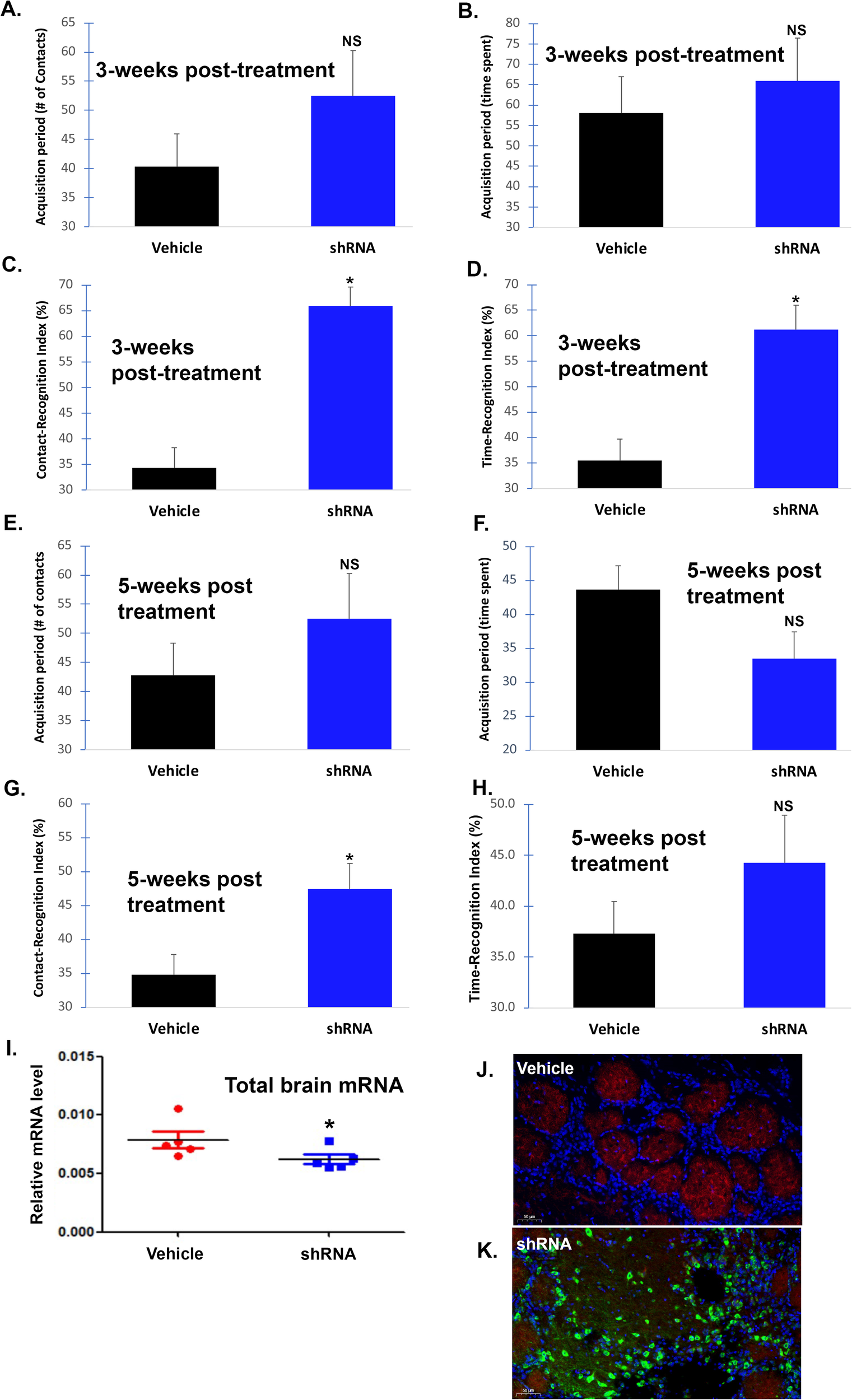 Intranasal adeno-associated virus delivery of AAV9-MeCP2-GFP-mouse HTR2A-shRNA improves memory in
rats.
Paper
2024
Translational Psychiatry |
DOI
Background
This study designed short-hairpin RNA (shRNA) targeting the human HTR2A gene to knock down the 5HT-2A receptor.
In iPSC-derived neurons, shRNA reduced 5HT-2A mRNA/protein and spontaneous electrical activity. Intranasal
AAV9-shRNA delivery bypassed the blood-brain barrier in mice and rats, decreasing anxiety-like behavior and
improving memory (104% in mice, 92% in rats). The findings support a non-invasive shRNA platform targeting HTR2A
for chronic anxiety and age-related cognitive decline. Thus, HTR2A-targeting shRNA has therapeutic potential for
anxiety and cognitive disorders.
Key Findings
The study showed that shRNA targeting HTR2A effectively knocked down the 5HT-2A receptor. In human
iPSC-differentiated glutamatergic neurons, shRNA reduced HTR2A mRNA by 34% and 5HT-2A immunofluorescence by 27%,
and decreased spontaneous electrical activity in multi-electrode array measures. In vivo, intranasal AAV9
delivery of shRNA crossed the blood-brain barrier and reduced 5HT-2A receptor expression in mouse brain and
olfactory bulb. It decreased anxiety-like behavior in mice at 5 weeks, with increased time in light box (34%)
and entries (22%). It also improved memory: aged mice treated with AAV9-CRISPR/Cas9 showed 104% increase in
spontaneous alternations, and rats treated with AAV9-shRNA showed 92% increase in contact-recognition index at 3
weeks and 36% at 5 weeks. The results suggest that targeting HTR2A may alleviate anxiety and age-related
cognitive decline.
Contribution
Creative Biogene performed RNA extraction and quantitative real-time PCR (qPCR) analyses in a blinded fashion
for human iPSC-derived neurons and mouse/rat brain or olfactory tissue, including total brain and olfactory bulb
samples. Their qPCR data supported validation of shRNA-mediated HTR2A mRNA knockdown after AAV9-shRNA treatment.
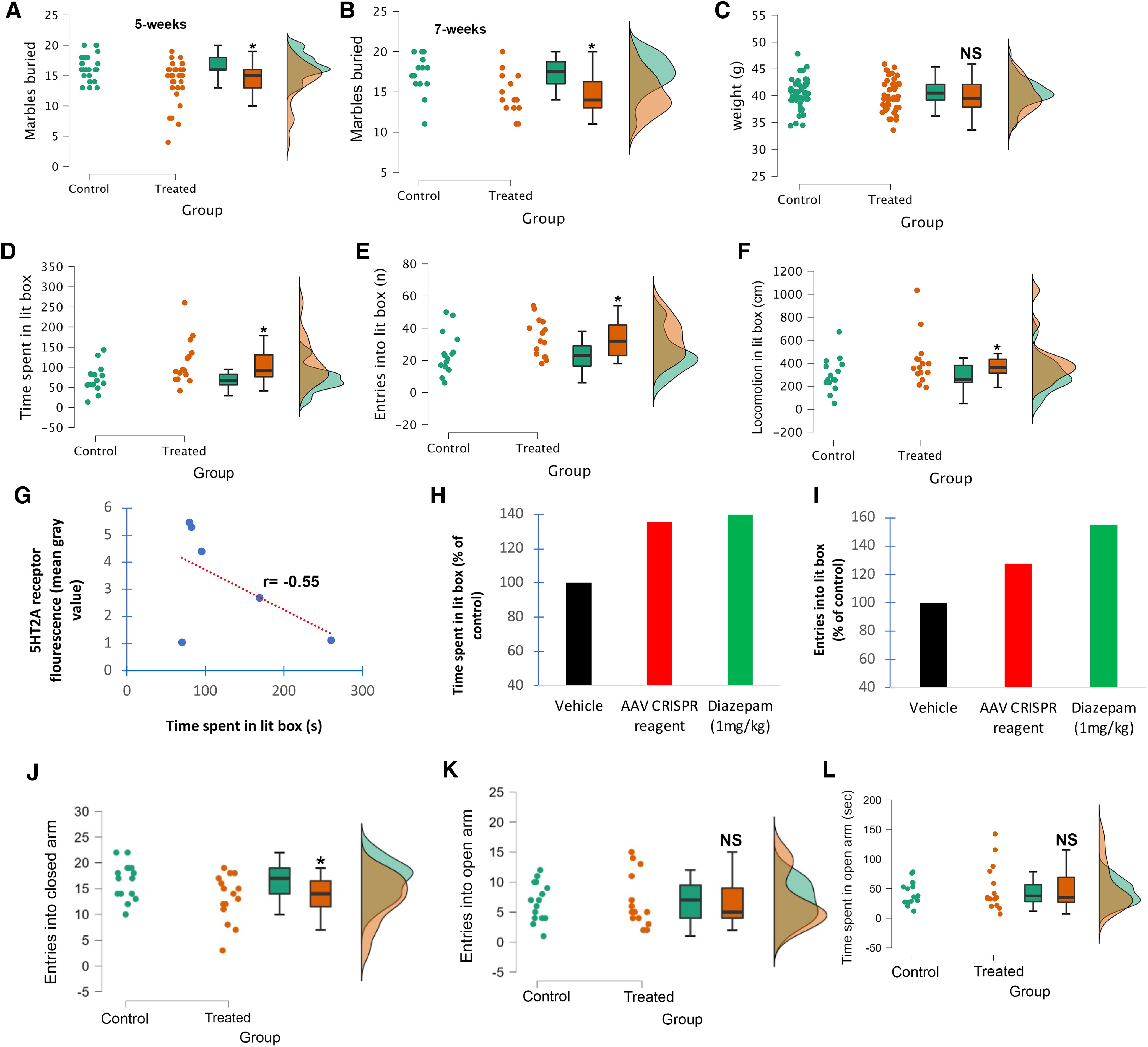 Intranasal AAV delivery of copackaged Cas9 DNA and a HTR2A-targeting gRNA decreases anxiety.
Paper
2023
Background
The study demonstrates a noninvasive intranasal AAV9 CRISPR/Cas9 platform for editing the HTR2A gene in the
mouse CNS. Dual AAV9 vectors delivering Cas9 and an HTR2A-targeting gRNA/ssODN reduced 5HT-2A receptor mRNA and
protein, decreased spontaneous neuronal network activity in vitro, and lowered anxiety-like behavior in mice.
The work shows blood–brain barrier bypass, durable modulation of a complex behavioral trait, and proof of
concept for gene-editing therapies targeting treatment-resistant anxiety and depression.
Key Findings
Intranasal AAV9-CRISPR/Cas9 delivery achieved widespread CNS expression of gRNA/GFP, including olfactory bulb,
cortex, cerebellum, interpeduncular nucleus, and pontine gray. In vitro, AAV9-Cas9 plus HTR2A gRNA decreased
cortical neuron spikes, network bursts, and synchrony without toxicity, with 41.4% editing at highest MOI. In
vivo, treated mice showed single-base deletions and nonsense mutations in HTR2A, an 8.46-fold reduction in mRNA,
and 68% lower 5HT-2A receptor immunofluorescence. Behavioral tests revealed reduced anxiety: fewer marbles
buried at 5 and 7 weeks, increased time/entries/locomotion in lit box, and fewer closed-arm entries in elevated
plus maze; effects were comparable to diazepam in time spent lit. Tail suspension showed no antidepressant-like
effect. Low editing frequency still produced significant anxiolytic effects.
Contribution
Creative Biogene performed RNA extraction and quantitative real-time PCR to measure HTR2A mRNA knockdown, and
genomic DNA isolation plus targeted next-generation sequencing to detect CRISPR/Cas9-induced indels in treated
mouse brain and olfactory bulb samples. These analyses provided molecular validation of on-target editing and
receptor downregulation.
* For research use only. Not intended for any clinical use.
 24x7 CUSTOMER SERVICE
 CONTACT US TO ORDER

