

In vivo genome correction is expected to produce lasting disease cures. However, effective stem cell editing remains challenging. In a new study, researchers from the University of Texas Southwestern Medical Center, Case Western Reserve University School of Medicine and ReCode Therapeutics have developed a method to deliver gene editing tools into the lungs to repair CFTR gene defects associated with cystic fibrosis. In the process, they overcame problems that have hindered previous therapies and believe that their method will soon be able to be used to treat human patients. The relevant research results were recently published in the journal Science, with the title "In vivo editing of lung stem cells for durable gene correction in mice".
Specifically, the authors demonstrated that optimized lung-targeted lipid nanoparticles (LNPs) enabled high levels of genome editing in lung stem cells, resulting in durable responses. Intravenous injection of gene-editing LNPs in activatable tdTomato mice resulted in >70% lung stem cell editing and sustained tdTomato expression in >80% of lung epithelial cells for 660 days. In cystic fibrosis, NG-ABE8e messenger RNA (mRNA)-sgR553X LNPs mediated >95% CFTR DNA correction, restored CFTR function in primary patient-derived bronchial epithelial cells, corrected intestinal organoids, and corrected the R553X nonsense mutation in 50% of lung stem cells in a mouse model of cystic fibrosis. These findings introduce tissue stem cell editing enabled by LNPs for disease-modifying genome correction.
| Cat.No. | Product Name | Price |
|---|---|---|
| PMCRL-0016 | Sox2 circRNA-LNP | Inquiry |
| PMCRL-0017 | Oct4 circRNA-LNP | Inquiry |
| PMCRL-0018 | Klf circRNA-LNP | Inquiry |
| PMCRL-0019 | c-Myc circRNA-LNP | Inquiry |
| PMCRL-0020 | Lin28 circRNA-LNP | Inquiry |
| PMmRNL-0001 | EGFP mRNA-LNP | Inquiry |
| PMmRNL-0002 | mCherry mRNA-LNP | Inquiry |
| PMmRNL-0003 | Firefly Luciferase mRNA-LNP | Inquiry |
| PMmRNL-0004 | Cas9-HA mRNA-LNP | Inquiry |
| PMmRNL-0005 | EGFP mRNA (no modificaiton)-LNP | Inquiry |
| PMmRNL-0006 | mCherry mRNA (no modificaiton)-LNP | Inquiry |
| PMmRNL-0007 | Firefly Luciferase mRNA (no modificaiton)-LNP | Inquiry |
| PMmRNL-0008 | spCas9 mRNA (no modificaiton)-LNP | Inquiry |
| PMmRNL-0009 | spCas9 mRNA (N1-Me-Pseudo UTP modified)-LNP | Inquiry |
| PMmRNL-0010 | SARS COV-2 Spike Protein (Alpha Variant) mRNA-LNP | Inquiry |
Cystic fibrosis is a genetic disease that affects the lungs and digestive tract, in which a defective CFTR gene causes a buildup of thick mucus in the lungs and throughout the digestive system. Many treatments have been developed to treat the symptoms of the disease, but there is still no cure.
| Cat.No. | Product Name | Price |
|---|---|---|
| CSC-DC003043 | Panoply™ Human CFTR Knockdown Stable Cell Line | Inquiry |
| CSC-RK0163 | Cftr Knockout Mouse Bone Marrow Leukocytes | Inquiry |
| CSC-RK0162 | Cftr Knockout Mouse Bone Marrow Neutrophils | Inquiry |
| CSC-RK0167 | Cftr Knockout Mouse Embryonic Fibroblasts | Inquiry |
| CSC-RK0166 | Cftr Knockout Mouse Embryonic Stem Cells | Inquiry |
| CSC-RK0170 | Cftr Knockout Mouse Heart Cells | Inquiry |
| CSC-RK0157 | Cftr Knockout Mouse Heart Fibroblasts | Inquiry |
| CSC-RK0171 | Cftr Knockout Mouse Kidney Cells | Inquiry |
| CSC-RK0168 | Cftr Knockout Mouse Spleen Cells | Inquiry |
| CSC-RK0158 | Cftr Knockout Mouse Spleen Fibroblasts | Inquiry |
| CSC-RT2753 | Human CFTR Knockout Cell Line-HEK293T | Inquiry |
| CSC-RI0081 | Human CFTR Stable Cell Line-CHO | Inquiry |
| CSC-RI0003 | Human CFTR Stable Cell Line-HEK293 | Inquiry |
| CSC-SC003043 | Panoply™ Human CFTR Over-expressing Stable Cell Line | Inquiry |
| AD03627Z | Human CFTR adenoviral particles | Inquiry |
Recently, scientists have tried to deliver gene-editing tools into the lungs to repair the problematic gene, but so far these efforts have failed because the tools have difficulty getting through the immune system and mucus. Other attempts have involved delivering treatments to the lungs via the bloodstream. They also failed because the liver filters them out before they reach the lungs.
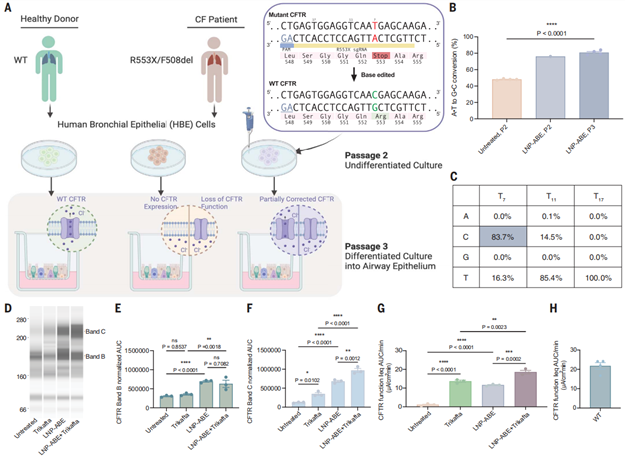
Figure 1. Efficient adenine base editing was achieved in lung basal cells in patient-derived HBE cells and CF mouse model. (Sun Y, et al., 2024)
In the new study, the authors developed a treatment. They tweaked the gene-editing machinery to prevent lipid nanoparticles from getting trapped in the liver. They also tweaked them to travel through the blood to the basal side of the lung epithelial lining. That way, the lipid nanoparticles could enter several types of lung cells, including basal cells.
The authors tested the approach in mice that had been genetically engineered to have cystic fibrosis. The treatment proved highly effective. They found that the gene editors had reached their intended target and repaired the cystic fibrosis-causing mutation in half of the mice tested. When the successfully treated mice were monitored, they found that the treatment provided symptom relief for up to 22 months.
Reference
Sun Y, et al. In vivo editing of lung stem cells for durable gene correction in mice. Science, 2024, 384(6701): 1196-1202.