

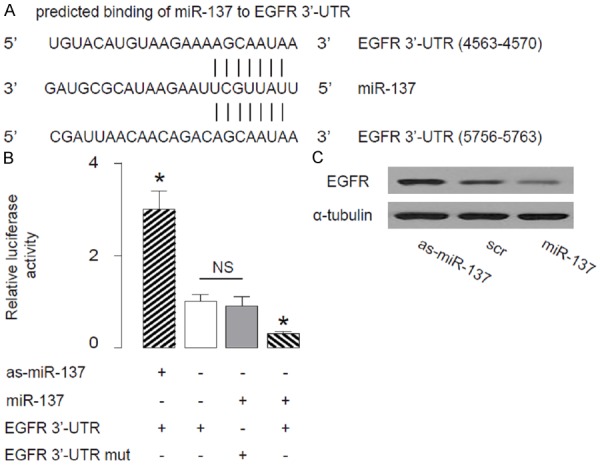
 EGFR is a target gene of miR-137.
MicroRNA-137 inhibits growth of glioblastoma through EGFR suppression
Paper
2017
American Journal of Translational Research |
DOI
Background
This study investigates the role of microRNA-137 (miR-137) in glioblastoma multiforme (GBM). It reports that miR-137 is significantly downregulated in GBM tissues compared with normal brain, and low levels correlate with poor overall survival. In A172 GBM cells, miR-137 overexpression inhibits proliferation and increases apoptosis, whereas miR-137 depletion promotes growth and reduces apoptosis. Mechanistically, bioinformatics and luciferase assays identify EGFR mRNA as a direct miR-137 target via its 3′-UTR. miR-137 suppresses EGFR translation and downstream signaling, suggesting miR-137 acts as a tumor suppressor in GBM.
Key Findings
The study found that miR-137 expression was significantly lower in 35 GBM tissue samples than in paired adjacent normal brain tissues. Low miR-137 levels were associated with shorter overall survival and poor prognosis, with multivariate Cox analysis showing a hazard ratio of 5.1. In the A172 GBM cell line, transfection with miR-137 mimics reduced cell proliferation and increased apoptosis, accompanied by decreased Bcl-2 and increased Caspase 9. Conversely, antisense miR-137 increased growth and suppressed apoptosis, with opposite Bcl-2/Caspase 9 changes. Bioinformatics identified two miR-137 binding sites in the EGFR 3′-UTR. Dual-luciferase reporter assays using wild-type and mutant EGFR 3′-UTR constructs confirmed direct targeting, and Western blot showed reduced EGFR protein. Thus, miR-137 inhibits GBM growth at least partly by targeting EGFR and suppressing EGFR signaling.
Contribution
Creative Biogene provided the EGFR 3′-UTR reporter plasmid (pRL-EGFR) used in this study. This reagent enabled the dual-luciferase reporter assay that confirmed direct binding of miR-137 to the EGFR 3′-UTR, a key mechanistic finding. Without this plasmid, the direct target validation would not have been possible.