Transfected Stable Cell Lines
Reliable | High-Performance | Wide Rage
Precision reporter, kinase, immune receptor, biosimilar, Cas9, and knockout stable cell lines for diverse applications.




Cat. No. : CSC-RT2645
Target Gene : LDLR Host Cell : HEK293T
Size : >1x10⁶ cells/vial Validation : Sequencing
| Cat. No. | CSC-RT2645 |
| Description | This cell line is a stable cell line with a homozygous knockout of human LDLR using CRISPR/Cas9. |
| Cell Type | Epithelial |
| Target Gene | LDLR |
| Host Cell | HEK293T |
| Host Cell Species | Homo sapiens (Human) |
| Genotype | LDLR (-/-) |
| Size | 2x10^6 cells/vial, 1mL |
| Validation | Sequencing |
| Sequencing Result | Homozygous: 44 bp deletion in exon |
| Revival | Rapidly thaw cells in a 37°C water bath. Transfer contents into a tube containing pre-warmed media. Centrifuge cells and seed into a 25 cm2 flask containing pre-warmed media. |
| Media Type | Cells were cultured in DMEM supplemented with 10% fetal bovine serum. |
| Growth Properties | Cells are cultured as a monolayer at 37°C in a humidified atmosphere with 5% CO2. Split at 80-90% confluence, approximately 1:3-1:6. |
| Freeze Medium | Complete medium supplemented with 10% (v/v) DMSO |
| Mycoplasma | Negative |
| Format | One frozen vial containing millions of cells |
| Storage | Liquid nitrogen |
| Safety Considerations |
The following safety precautions should be observed. 1. Use pipette aids to prevent ingestion and keep aerosols down to a minimum. 2. No eating, drinking or smoking while handling the stable line. 3. Wash hands after handling the stable line and before leaving the lab. 4. Decontaminate work surface with disinfectant or 70% ethanol before and after working with stable cells. 5. All waste should be considered hazardous. 6. Dispose of all liquid waste after each experiment and treat with bleach. |
| Ship | Dry ice |
| Gene Name | LDLR low density lipoprotein receptor [ Homo sapiens ] |
| Gene Symbol | LDLR |
| Synonyms | FH; FHC; LDLCQ2 |
| GeneID | 3949 |
| Uni ProtID | P01130 |
| mRNA Refseq | NM_000527.4 |
| Protein Refseq | NP_000518.1 |
| Chromosome Location | 19p13.2 |
| Function | calcium ion binding; glycoprotein binding; low-density lipoprotein receptor activity; protein binding; very-low-density lipoprotein particle receptor activity; |
| Pathway | Bile secretion, organism-specific biosystem; Bile secretion, conserved biosystem; Chylomicron-mediated lipid transport, organism-specific biosystem; DNA damage response (only ATM dependent), organism-specific biosystem; Endocytosis, organism-specific biosystem; Endocytosis, conserved biosystem; Hepatitis C, organism-specific biosystem; |
| MIM | 606945 |
The low-density lipoprotein receptor (LDLR) is a key protein that plays an important role in regulating cholesterol levels in the human body. The main function of the LDLR is to bind low-density lipoprotein (LDL), the main carrier of cholesterol in the blood, to be internalized into cells. This process begins when LDL particles (composed of cholesterol and a specific protein called apolipoprotein B-100) bind to LDLR on the cell surface. This binding triggers endocytosis, a cellular mechanism that engulfs LDL particles into cells. Subsequently, LDL particles are transported to lysosomes, where they are degraded and their cholesterol content is released into the cell to meet various metabolic needs.
LDLR function is regulated by various intracellular and extracellular factors. For example, LDLR levels on the cell surface are tightly regulated by sterol regulatory element binding proteins (SREBPs), which respond to cellular cholesterol levels. In addition, proprotein convertase subtilisin/kexin type 9 (PCSK9) has emerged as a key regulator of LDLR. PCSK9 binds to the LDLR, causing its degradation and reducing the number of receptors available to clear LDL cholesterol from the blood. Mutations in the LDLR gene can cause familial hypercholesterolemia (FH), an inherited disorder characterized by high cholesterol levels and an increased risk of cardiovascular disease. People with FH often have elevated LDL cholesterol because their cells cannot effectively clear LDL particles from the blood due to defective or insufficient LDL receptors.
Lentiviral vectors (LVs) are reliable vehicles for gene therapy because they can efficiently integrate transgenes into the host cell genome. However, LVs with long or complex expression cassettes are often produced at low titers and have reduced gene transfer capacity, creating barriers to clinical and commercial applications. Improvements in packaging cell lines and methods may enable the production of complex vectors with higher titers and infectivity and could improve the production of many different LVs. In this study, researchers identified two host restriction factors that hinder LV production in HEK293T packaging cells, 2′-5′-oligoadenylate synthetase 1 (OAS1) and low-density lipoprotein receptor (LDLR). Knockout of these two genes individually resulted in an approximately 2-fold increase in viral titers. The researchers created a monoclonal cell line, CRISPRed HEK293T to Disrupt Antiviral Response (CHEDAR), by sequentially knocking out OAS1, LDLR, and PKR, a factor previously found to hinder LV titers. Packaging in CHEDAR resulted in an approximately 7-fold increase in physical particles, full-length vector RNA, and vector titer.
Because homozygous deletion of ATR results in chromosome breakage and failure to proliferate in culture, researchers selected ATR KD clones with 63% indel and 63% KO rates, which showed significantly reduced protein expression (Figure 1A). Interferon α and β receptor subunit 1 (IFNAR1), OAS1, and LDLR were successfully knocked out, as shown in Figures 1A and 1B. Unstimulated CD34+ hematopoietic stem and progenitor cells (HSPCs), which are known to have no or low expression of LDLR28, were used as negative controls when measuring LDLR expression in LDLR knockout cells by flow cytometry (Figure 1B). Targeted CRISPR-Cas9 screening showed that individual disruption of IFNAR1, OAS1, ATR, and LDLR genes each increased titer by approximately 2-fold (Figure 1C). PKR knockout HEK293T cells had a 4.1±1.1-fold increase in titer. IFNAR1 knockout HEK293T cells had a 2.4±0.7-fold increase in titer. OAS1 knockout HEK293T cells had a 2.3±0.8-fold increase in titer. ATR knockdown cells had a 2.2±0.8-fold increase in titer. LDLR knockout HEK293T cells had a 2.8±0.9-fold increase in titer.
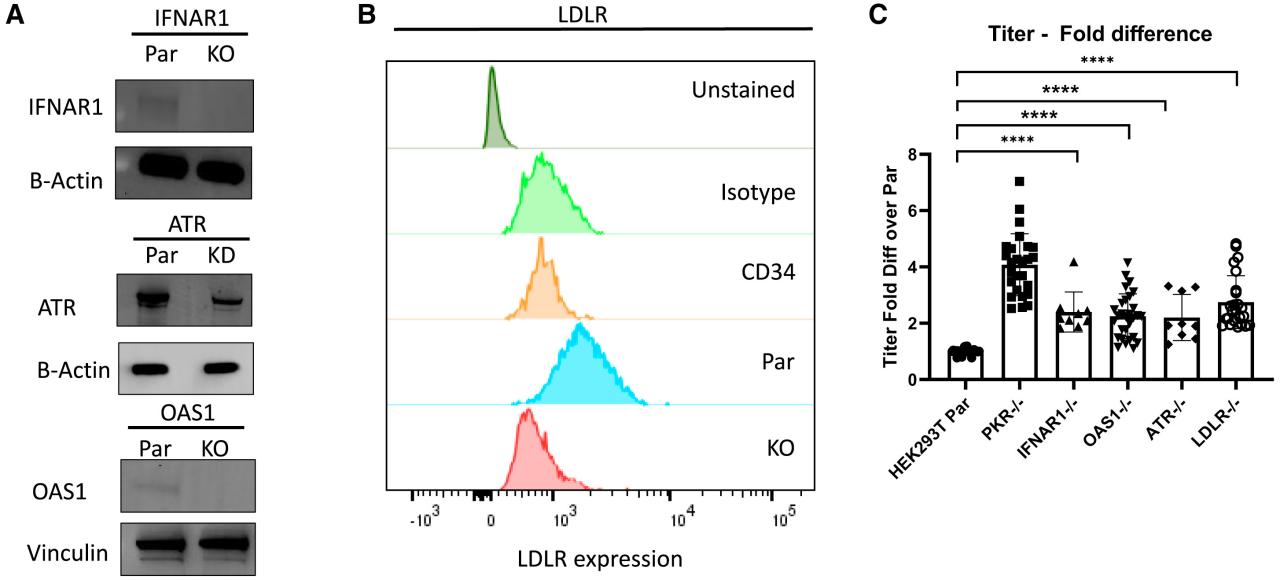 Figure 1. Knocking out IFNAR1, ATR, OAS1, and LDLR in 293T cells increased titers. (Han J, et al., 2021)
Human LDLR (Low Density Lipoprotein Receptor) knockout cell lines, especially using HEK293T cells, are powerful tools for a wide range of biomedical research and therapeutic development applications. Here are some key applications:
LDL Metabolism Research: The Human LDLR Knockout Cell Line-HEK293T is widely used to study the mechanisms of LDL (Low Density Lipoprotein) metabolism. Given the key role of the LDLR (Low Density Lipoprotein Receptor) in the uptake of LDL particles by cells, this cell line provides a valuable model for exploring how LDLR deficiency affects cholesterol and lipid metabolism.
Atherosclerosis Research: Atherosclerosis is a disease characterized by the accumulation of cholesterol-rich plaques in the arteries. Researchers use this model to better understand the pathophysiological processes that lead to plaque formation when the LDLR loses its function, thereby identifying new therapeutic targets for cardiovascular disease.
Drug Testing and Development: Researchers use the Human LDLR Knockout Cell Line-HEK293T to screen and evaluate new lipid-lowering drugs. By testing drug compounds in cells lacking LDLR, scientists can determine the efficacy and mechanism of action of drugs designed to reduce blood LDL levels.
Pathway Analysis: Researchers can analyze the downstream effects of LDLR knockout on intracellular signaling, gene expression, and metabolic processes, helping to delineate the broader impact of LDL-related perturbations.
A: DMEM supplemented with 10% fetal bovine serum. <br> It is not required to add the selection antibiotics when culturing the KO cells.
A: The knockout cell product is validated by PCR amplification and Sanger Sequencing to confirm the mutation at the genomic level. Please find the detailed mutation info in the datasheet.
A: Single clonal cell.
A: No. This knockout cell product is generated using the CRISPR/Cas9 system to induce small insertions or deletions (indels) resulting in frameshift mutations. Although these frameshift mutations typically disrupt the coding gene, there is a possibility that the non-functional transcript may still be transcribed. Consequently, this could potentially yield misleading results when analyzed by RT-qPCR.
A: The cell line should be stored in liquid nitrogen for long-term preservation.
A: For most cases, we often keep at least 2 clones with different frameshift mutations. Please feel free to contact us to check if there are additional available clones.
If your question is not addressed through these resources, you can fill out the online form below and we will answer your question as soon as possible.
LDLR knockout cell lines can be used to test the efficacy of drug candidates that work by increasing the activity of LDLR or independent LDLR-mediated mechanisms that lead to the removal of cholesterol from the bloodstream. The LDLR cell line is very helpful for our research.
Write a review of your use of Biogene products and services in your research. Your review can help your fellow researchers make informed purchasing decisions.
Copyright © 2026 Creative Biogene. All rights reserved.