Transfected Stable Cell Lines
Reliable | High-Performance | Wide Rage
Precision reporter, kinase, immune receptor, biosimilar, Cas9, and knockout stable cell lines for diverse applications.


Cat. No. : CSC-RT2725
Target Gene : B2M Host Cell : K562
Size : >1x10⁶ cells/vial Validation : Sequencing
| Cat. No. | CSC-RT2725 |
| Description | This cell line is a stable cell line with a homozygous knockout of human B2M using CRISPR/Cas9. |
| Cell Type | Hematopoietic |
| Target Gene | B2M |
| Host Cell | K562 |
| Host Cell Species | Homo sapiens (Human) |
| Genotype | B2M (-/-) |
| Size | 2x10^6 cells/vial |
| Validation | Sequencing |
| Sequencing Result | Homozygous: 1 bp deletion in exon |
| Culture Condition | Cells are cultured at 37°C in a humidified atmosphere with 5% CO2. |
| Subcultivation Ratio | Split saturated culture every 2-3 days |
| Revival | Rapidly thaw cells in a 37°C water bath. Transfer contents into a tube containing pre-warmed media. Centrifuge cells and seed into a 25 cm2 flask containing pre-warmed media. |
| Mycoplasma | Negative |
| Format | One frozen vial containing millions of cells |
| Storage | Liquid nitrogen |
| Safety Considerations |
The following safety precautions should be observed. 1. Use pipette aids to prevent ingestion and keep aerosols down to a minimum. 2. No eating, drinking or smoking while handling the stable line. 3. Wash hands after handling the stable line and before leaving the lab. 4. Decontaminate work surface with disinfectant or 70% ethanol before and after working with stable cells. 5. All waste should be considered hazardous. 6. Dispose of all liquid waste after each experiment and treat with bleach. |
| Ship | Dry ice |
| Gene Name | B2M beta-2-microglobulin [ Homo sapiens ] |
| Gene Symbol | B2M |
| Gene Description | beta-2-microglobulin |
| GeneID | 567 |
| Uni ProtID | P61769 |
| mRNA Refseq | NM_004048.2 |
| Protein Refseq | NP_004039.1 |
| Chromosome Location | 15q21-q22.2 |
| Function | protein binding; |
| Pathway | Adaptive Immune System, organism-specific biosystem; Amyloids, organism-specific biosystem; Antigen Presentation: Folding, assembly and peptide loading of class I MHC, organism-specific biosystem; Antigen processing and presentation, organism-specific biosystem; Antigen processing and presentation, conserved biosystem; Antigen processing-Cross presentation, organism-specific biosystem; Class I MHC mediated antigen processing & |
| MIM | 109700 |
The B2M (beta-2-microglobulin) gene gene is located on chromosome 15q21.1 and is approximately 66 kilobases in length. Beta-2-microglobulin is a key component of MHC class I molecules and is essential for presenting peptide antigens to the immune system. This presentation is essential for the immune system's ability to recognize and respond to infected or malignant cells. Structurally, beta-2-microglobulin is approximately 12 kDa in size and is characterized by a primarily beta-pleated sheet structure. This structure can form amyloid fibrils under certain pathological conditions, leading to diseases such as dialysis-associated amyloidosis.
The gene is ubiquitously expressed, with high levels observed in tissues such as the spleen and lymph nodes. This widespread expression reflects its fundamental role in immune surveillance. In addition to its role in the immune system, beta-2-microglobulin has been implicated in other biological processes. For example, studies have shown that it has antimicrobial activity in amniotic fluid, and changes in its levels have been associated with various pathological conditions, including tumorigenesis and inflammatory diseases. Mutations in the B2M gene can lead to a variety of diseases. A notable example is hypercatabolic hypoproteinemia, where mutations cause rapid protein breakdown, resulting in a significant drop in protein levels in the blood. Another disease associated with B2M mutations is familial visceral amyloidosis, Ostertag type, in which amyloid fibrils accumulate in internal organs, leading to organ dysfunction.
The human K562 leukemia cell line, used as a scaffold for artificial antigen-presenting cells (aAPCs) for in vitro lymphocyte expansion, normally does not express major histocompatibility complex (MHC) molecules. However, when stimulated with human T lymphocyte culture supernatant, K562 cells upregulate beta-2 microglobulin (B2M) and MHC class I expression, thereby inducing allo-specific T cells. Here, researchers disrupted the B2M locus in K562 cells by CRISPR/Cas9 and obtained MHC class I-negative K562 cells. A K562-based MHC class I-negative aAPC line was further generated by zinc finger nuclease-mediated insertion of costimulatory molecules into the AAVS1 locus. This aAPC line can attenuate allogeneic immune responses but supports robust antigen-independent and CD19 antigen-specific chimeric antigen receptor-T cell expansion in vitro. These results suggest that B2M-knockout K562 cells provide a new scaffold for the construction of aAPCs and their broader application in adoptive immunotherapy.
K562 cells are commonly used as feeder cells for large-scale expansion of αβ-T cells. To test the stimulating function of B2M knockout K562-based aAPCs for antigen-independent T-cell expansion, PBMCs were treated with CD3/CD28 antibody-coated micro-Dynabeads for 1 week to activate T cells. T cells were then collected to mix with inactivated K562B or K562A cells at an 1:50 ratio and expanded in the presence of anti-CD3 antibody, OKT-3, for 2 weeks (Figure 1A). With this method, a total cell expansion of 1000- to 2000-fold was observed at the end of the 14-day culture in a representative study (Figure 1B). The researchers further investigated the composition of the cell population after 2 weeks of expansion (Figure 1C). The CD8+ αβ-T-cell population constituted the major portion (60–75%) followed by the CD4+ αβ-T-cell population (20–40%). CD3- CD56+ NK cells percentage was slightly increase from 3 to 13% during Dynabeads stimulation due to the loss of monocytes and other non-T/NK lymphocytes, but a decrease in the proportion of NK cells from 3 to 5% was observed during the 14-day T cell/K562 coculture. There was no obvious expansion of the γδ-T-cell population (1.5–3%). These studies suggest that B2M knockout in K562 does not affect its ability to function as aAPC for antigen-independent T cell expansion.
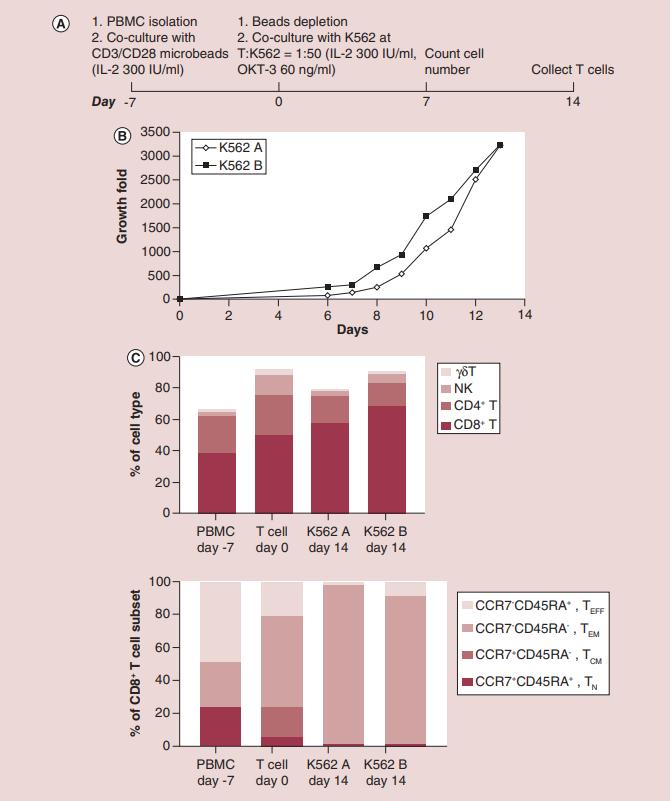 Figure 1. Antigen-independent T-cell expansion with β-2 microglobulin-knockout K562-based artificial antigen presenting cells. (Zha S, et al., 2019)
The Human B2M (Beta-2-Microglobulin) Knockout Cell Line - K562 is an important tool in biomedical research, offering a variety of applications that facilitate studies in immunology, oncology, drug development, and cell biology. Here are some key applications:
1. Immunogenicity Studies: The B2M knockout K562 cell line enables researchers to study the role of this gene in antigen presentation and its impact on immune recognition, particularly in the context of major histocompatibility complex (MHC) class I molecules.
2. Cancer Research: B2M is often overexpressed in various cancers, leading to tumor progression and metastasis. The B2M knockout K562 cell line can serve as a model to study the role of B2M in tumor biology, providing insights into new therapeutic targets for cancer treatment.
3. Drug Screening and Development: This cell line is an excellent model for high-throughput screening of anticancer drugs. By using B2M knockout K562 cells, researchers can evaluate drug efficacy and toxicity in the absence of B2M, helping to identify compounds that specifically target pathways affected by B2M loss.
4. Gene Function Studies: B2M knockout cell lines facilitate functional genomics studies to delineate biological pathways and molecular mechanisms regulated by B2M. Researchers can perform gene expression analysis and signaling pathway studies to understand the role of B2M in cellular processes.
5. Immunotherapy Studies: Given the relevance of B2M in immune recognition, this cell line is essential for developing and testing immunotherapy strategies such as chimeric antigen receptor (CAR) T cell therapy. Researchers can evaluate how B2M loss affects the effectiveness of CAR-T cells and other immune-based therapies.
A: RPMI1640 supplemented with 10% fetal bovine serum. <br> It is not required to add the selection antibiotics when culturing the KO cells.
A: The knockout cell product is validated by PCR amplification and Sanger Sequencing to confirm the mutation at the genomic level. Please find the detailed mutation info in the datasheet.
A: Single clonal cell.
A: No. This knockout cell product is generated using the CRISPR/Cas9 system to induce small insertions or deletions (indels) resulting in frameshift mutations. Although these frameshift mutations typically disrupt the coding gene, there is a possibility that the non-functional transcript may still be transcribed. Consequently, this could potentially yield misleading results when analyzed by RT-qPCR.
A: The cell line should be stored in liquid nitrogen for long-term preservation.
A: For most cases, we often keep at least 2 clones with different frameshift mutations. Please feel free to contact us to check if there are additional available clones.
If your question is not addressed through these resources, you can fill out the online form below and we will answer your question as soon as possible.
The Human B2M Knockout Cell Line-K562's consistent performance has significantly accelerated our research on immunotherapy. The knockout efficiency is remarkably high, ensuring reliable and reproducible results every time.
The K562 B2M knockout cell line has played an important role in our drug screening experiments, providing clear insights into MHC class I-dependent processes. We have saved countless hours due to its stable and predictable growth properties.
Write a review of your use of Biogene products and services in your research. Your review can help your fellow researchers make informed purchasing decisions.
Copyright © 2026 Creative Biogene. All rights reserved.