Transfected Stable Cell Lines
Reliable | High-Performance | Wide Rage
Precision reporter, kinase, immune receptor, biosimilar, Cas9, and knockout stable cell lines for diverse applications.



Cat. No. : CSC-RT0015
Target Gene : BRCA2 Host Cell : DLD-1
Size : >1x10⁶ cells/vial Validation : Sequencing
| Cat. No. | CSC-RT0015 |
| Description | DLD-1-BRCA2 (-/-) is a cell line with a homozygous knockout of human BRCA2 |
| Target Gene | BRCA2 |
| Host Cell | DLD-1 |
| Host Cell Species | Homo sapiens (Human) |
| Size | >1x10⁶ cells/vial |
| Validation | Sequencing |
| Revival | Rapidly thaw cells in a 37°C water bath. Transfer contents into a tube containing pre-warmed media. Centrifuge cells and seed into a 25 cm2 flask containing pre-warmed media. |
| Mycoplasma | Negative |
| Format | One frozen vial containing millions of cells |
| Storage | Liquid nitrogen |
| Safety Considerations |
The following safety precautions should be observed. 1. Use pipette aids to prevent ingestion and keep aerosols down to a minimum. 2. No eating, drinking or smoking while handling the stable line. 3. Wash hands after handling the stable line and before leaving the lab. 4. Decontaminate work surface with disinfectant or 70% ethanol before and after working with stable cells. 5. All waste should be considered hazardous. 6. Dispose of all liquid waste after each experiment and treat with bleach. |
| Ship | Dry ice |
| Gene Name | BRCA2 breast cancer 2, early onset [ Homo sapiens ] |
| Gene Symbol | BRCA2 |
| Synonyms | FAD; FACD; FAD1; GLM3; BRCC2; FANCB; FANCD; PNCA2; FANCD1; BROVCA2 |
| Gene Description | breast cancer 2, early onset |
| GeneID | 675 |
| Uni ProtID | P51587 |
| mRNA Refseq | NM_000059.3 |
| Protein Refseq | NP_000050.2 |
| Chromosome Location | 13q12.3 |
| Function | H3 histone acetyltransferase activity; H4 histone acetyltransferase activity; gamma-tubulin binding; NOT histone acetyltransferase activity; protease binding; protein binding; single-stranded DNA binding; |
| Pathway | DNA Repair, organism-specific biosystem; Double-Strand Break Repair, organism-specific biosystem; FOXM1 transcription factor network, organism-specific biosystem; Fanconi Anemia pathway, organism-specific biosystem; Fanconi anemia pathway, organism-specific biosystem; Fanconi anemia pathway, conserved biosystem; Homologous DNA pairing and strand exchange, organism-specific biosystem; |
| MIM | 600185 |
BRCA2 (breast cancer susceptibility protein type 2) is an important gene in the human genome that plays an important role in maintaining genomic stability. BRCA2 is located on chromosome 13 and encodes a large protein consisting of approximately 3,418 amino acids that is essential for repairing DNA damage via homologous recombination. This gene is critical because mutations within BRCA2 are strongly associated with an increased risk of developing hereditary breast and ovarian cancer, as well as other malignancies.
The main function of BRCA2 is to promote the accurate repair of double-strand DNA breaks, which are one of the most lethal types of DNA damage. It does this by controlling the RAD51 protein, a key player in homologous recombination. By helping homologous DNA sequences to align and pair correctly, BRCA2 ensures that any double-strand breaks are accurately repaired, thereby preventing genomic instability that can lead to cancer. BRCA2 gene mutations can be inherited in an autosomal dominant manner, increasing an individual's risk of developing cancer. Women who carry a harmful BRCA2 mutation have a lifetime risk of developing breast cancer of up to 70%. Men with BRCA2 mutations are also at increased risk, particularly for prostate and pancreatic cancers.
Poly ADP-ribose polymerase 1 (PARPi) inhibitors are highly efficient in killing cells deficient in homologous recombination (HR). As a result, PARPi have been used successfully in the clinic to treat BRCA2-mutant tumors. However, positive responses to PARPi are not universal, even in patients with HR defects. Here, researchers present results from a genome-wide CRISPR knockout and activation screen that reveals genetic determinants of PARPi response in wild-type or BRCA2 knockout cells. Surprisingly, the report reports that depletion of the ubiquitin ligase HUWE1 or the histone acetyltransferase KAT5 (the top hits from the screen) strongly reverses PARPi sensitivity caused by BRCA2 deficiency. The researchers identify distinct mechanisms of resistance, where HUWE1 loss increases RAD51 levels to partially restore HR, while KAT5 depletion rewires double-strand break repair by promoting 53BP1 binding to double-strand breaks. This work provides a comprehensive set of putative biomarkers that advance the understanding of PARPi responses and identifies novel pathways of PARPi resistance in BRCA2-deficient cells.
Few studies have reported proteins that cause PARPi resistance when overexpressed. Interestingly, however, the best gene in the researchers' screen, ABCB1, had previously been identified as a mechanism of PARPi resistance. This gene encodes the protein MDR-1 (multidrug resistance protein 1), a drug efflux pump whose overexpression has been associated with acquired resistance to olaparib in ovarian cancer cell lines. To validate these results, the researchers generated HeLa BRCA2KO cells with transcriptional activation of the ABCB1 gene (Figure 1a). They found that the BRCA2 knockout, ABCB1-overexpressing cell line was as resistant to PARPi as the BRCA2-proficient parental HeLa line (Figure 1b). Previously, PARPi treatment has been shown to induce apoptosis in BRCA2-deficient cells. Consistent with this, the study found that olaparib treatment led to a more than sixfold increase in cells positive for Annexin V, a marker of apoptosis, in BRCA2 knockout cells. However, overexpression of ABCB1 restored olaparib-induced apoptosis to control levels (Figure 1c). Overall, these findings validated the results of the CRISPR activation screen.
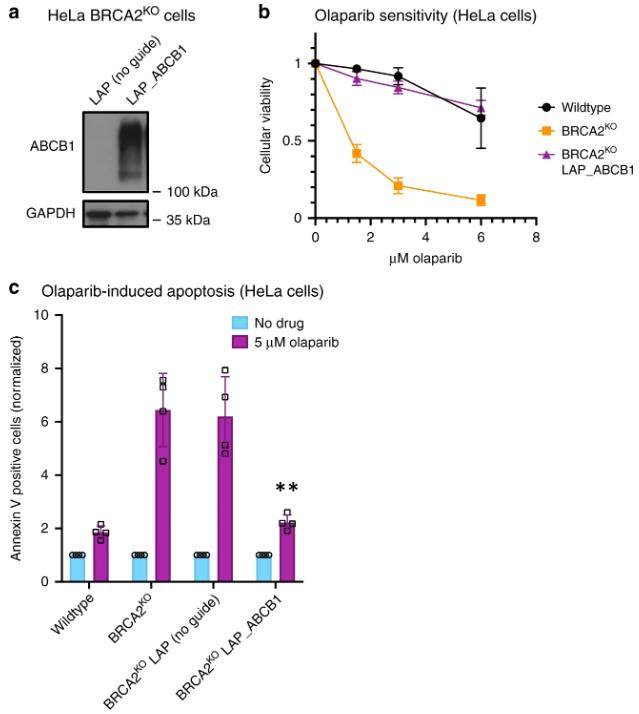 Figure 1. Overexpression of ABCB1, the top hit from the CRISPR activation screen, causes PARPi resistance in BRCA2 knockout cells. (Clements K E, et al., 2020)
The Human BRCA2 Knockout Cell Line-DLD-1 is a powerful tool in the study of cancer biology, genetic research, and drug development. Here are some key applications of this cell line:
Cancer Research: BRCA2 knockout DLD-1 cells are utilized to study the mechanisms of cancer development and progression, particularly in breast and ovarian cancers.
Drug Screening: These cells are instrumental in high-throughput screening of potential cancer therapeutics and assessing drug efficacy and resistance.
Genomic Studies: Researchers use these cells to investigate the role of BRCA2 in DNA repair, genome stability, and the cellular response to DNA damage.
Functional Analysis: The cell line serves as a model to explore BRCA2's functions and interactions with other proteins involved in cell cycle regulation and tumor suppression.
Gene Editing: These cells are a valuable tool for CRISPR/Cas9 and other gene editing technologies to assess the impact of BRCA2 mutations and to engineer new genetic models.
A: The knockout cell product is validated by PCR amplification and Sanger Sequencing to confirm the mutation at the genomic level. Please find the detailed mutation info in the datasheet.
A: Single clonal cell.
A: No. This knockout cell product is generated using the CRISPR/Cas9 system to induce small insertions or deletions (indels) resulting in frameshift mutations. Although these frameshift mutations typically disrupt the coding gene, there is a possibility that the non-functional transcript may still be transcribed. Consequently, this could potentially yield misleading results when analyzed by RT-qPCR.
A: The cell line should be stored in liquid nitrogen for long-term preservation.
A: For most cases, we often keep at least 2 clones with different frameshift mutations. Please feel free to contact us to check if there are additional available clones.
If your question is not addressed through these resources, you can fill out the online form below and we will answer your question as soon as possible.
Research BRCA2 gene, this product can perfectly knock out human BRCA2 gene, high efficiency and low cost
Samples can be tested in a variety of simple experiments, greatly speeding up the process.
This product is easy to handle and requires essentially no fuss, but its results are very clear and very convincing.
This product is easy to handle and requires essentially no fuss, but its results are very clear and very convincing.
This transfection was more successful than the previous experimental materials, and I couldn't help but feel that this reagent was so amazing, and my experimental process was one step faster.
In this product, gene knockout is such a simple thing, and the results of repeated experimental experiments are also very clear.
In my follow-up experiments, there will also be gene knockout experiments, I will give priority to this brand of transfection reagent, there is a first surprise, I want to have the next time.
I'm so proud of my experimental results, and I think the knockout transfection reagent I used is a big contribution.
This is not the first time I have used this brand's products, and the second time I have used it, the effect is still very strong.
Having used trial packs of other reagents from this company before, this is the first time I ordered a gene knockout reagent, and it worked very well.
Write a review of your use of Biogene products and services in your research. Your review can help your fellow researchers make informed purchasing decisions.
Copyright © 2026 Creative Biogene. All rights reserved.