

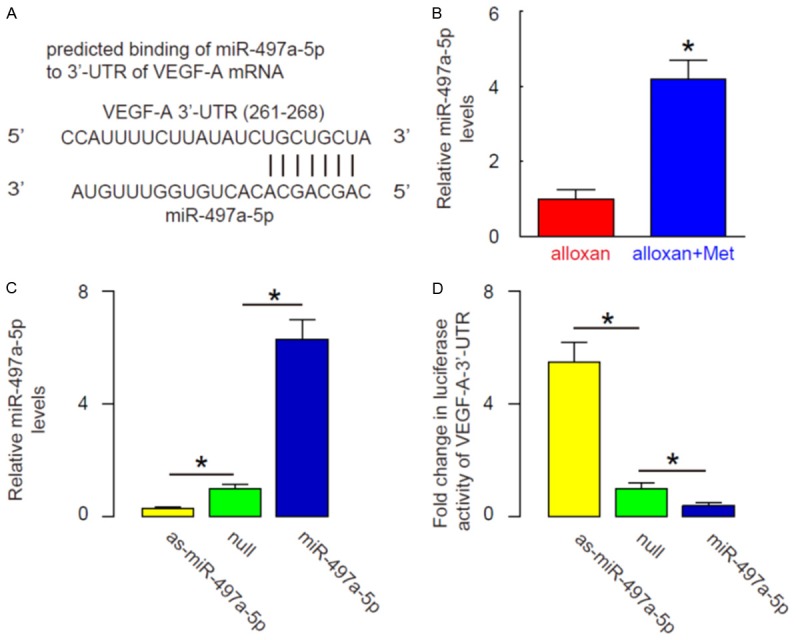
 MiR-497a-5p targets 3’-UTR of VEGF-A mRNA to inhibit its expression.
Metformin inhibits development of diabetic retinopathy through microRNA-497a-5p
Paper
2017
American Journal of Translational Research |
DOI
Background
Metformin, a first-line drug for type 2 diabetes, has been reported to alleviate diabetic retinopathy (DR), but mechanisms remain unclear. Using alloxan-induced diabetic mice, this study shows metformin does not prevent diabetes or hyperglycemia but reduces DR severity and retinal neovascularization. Metformin lowers VEGF-A protein without affecting VEGF-A mRNA and increases miR-497a-5p, which directly targets the VEGF-A 3’-UTR to inhibit translation. These findings reveal that metformin mitigates DR via miR-497a-5p-mediated post-transcriptional suppression of VEGF-A.
Key Findings
Alloxan induced sustained diabetes and DR in mice. Metformin did not prevent hyperglycemia or beta-cell loss but significantly alleviated DR severity, mainly by attenuating retinal neovascularization at the neovascular stage. It did not alter avascular areas during early ischemia. Metformin reduced VEGF-A protein in mouse eyes without changing VEGF-A mRNA, indicating post-transcriptional regulation. It increased miR-497a-5p levels in mouse eyes. miR-497a-5p was confirmed to target the VEGF-A mRNA 3’-UTR by luciferase reporter assay. In MS1 epithelial cells, miR-497a-5p overexpression decreased VEGF-A protein while inhibition increased it, with no effect on VEGF-A mRNA. Thus, metformin induces miR-497a-5p to inhibit VEGF-A translation, reducing retinal neovascularization in DR.
Contribution
Creative Biogene provided the VEGF-A miRNA 3’-UTR luciferase reporter construct used in this study. This reagent enabled the dual-luciferase assay confirming that miR-497a-5p directly targets the VEGF-A mRNA 3’-UTR, a key step in demonstrating the post-transcriptional mechanism by which metformin-induced miR-497a-5p suppresses VEGF-A translation.