

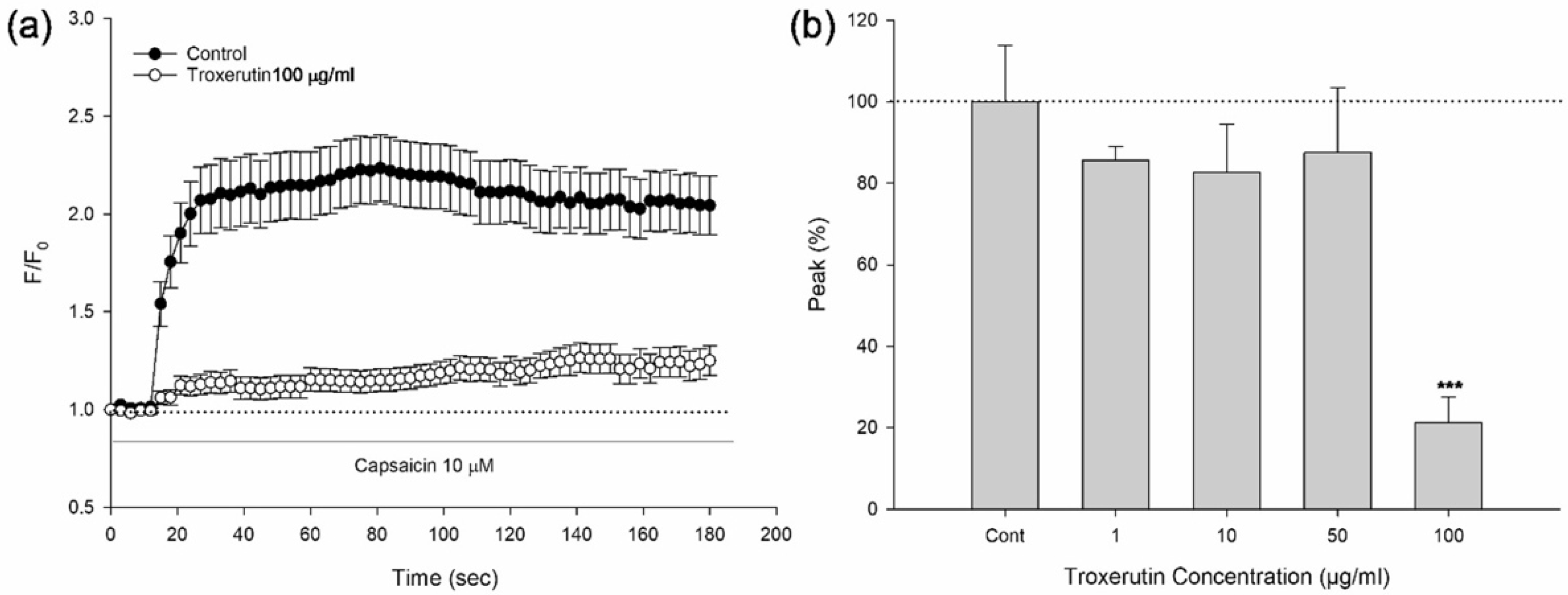
 Capsaicin-induced calcium influx in TRPV1-overexpressing HEK293T cells.
Drug–Target Interaction Deep Learning-Based Model Identifies the Flavonoid Troxerutin as a Candidate TRPV1 Antagonist
Paper
2023
Applied Sciences |
DOI
Background
Study uses MT-DTI deep learning model to screen natural compounds for TRPV1 antagonism. Predicted troxerutin as TRPV1 antagonist IC50 582.73 nM. Validated in TRPV1-overexpressing HEK293T cells, troxerutin inhibited capsaicin-induced calcium influx. Docking confirmed binding to hTRPV1. Small clinical trial (29 participants) showed 1% and 10% troxerutin lotions reduced capsaicin-induced skin redness. Suggests troxerutin as potential TRPV1 antagonist/cosmeceutical for sensitive skin. This study demonstrates an AI-aided target-based drug repurposing approach and provides a useful reference for integrating deep learning with biological validation in cosmeceutical discovery.
Key Findings
From the COCONUT natural product library, MT-DTI predicted troxerutin as a candidate TRPV1 antagonist (KD 140.08 nM, IC50 582.73 nM) with pharmacophore similarity to JTS-653. In TRPV1-overexpressing HEK293T cells, troxerutin (100 µg/mL) significantly inhibited capsaicin (10 µM)-induced calcium influx, confirming target-dependent antagonism. Structural modeling and docking showed troxerutin binds human TRPV1 at the S4–S5 linker, interacting with E570, I569, and A566, similar to the antagonist JTS-653. A clinical study with 29 participants found both 1% and 10% w/v troxerutin lotions reduced capsaicin-induced skin redness compared with vehicle, with soothing rates around 84–88%. These findings identify troxerutin as a potential naturally derived TRPV1 antagonist for sensitive skin and support AI-driven drug discovery.
Contribution
Creative Biogene provided the TRPV1-overexpressing HEK293T cell line used for in vitro calcium influx assays. This validated target-dependent antagonism of troxerutin and supported the study's key functional evidence linking MT-DTI prediction to biological activity. The cell model was essential for confirming that troxerutin blocks capsaicin-induced TRPV1 activation.