

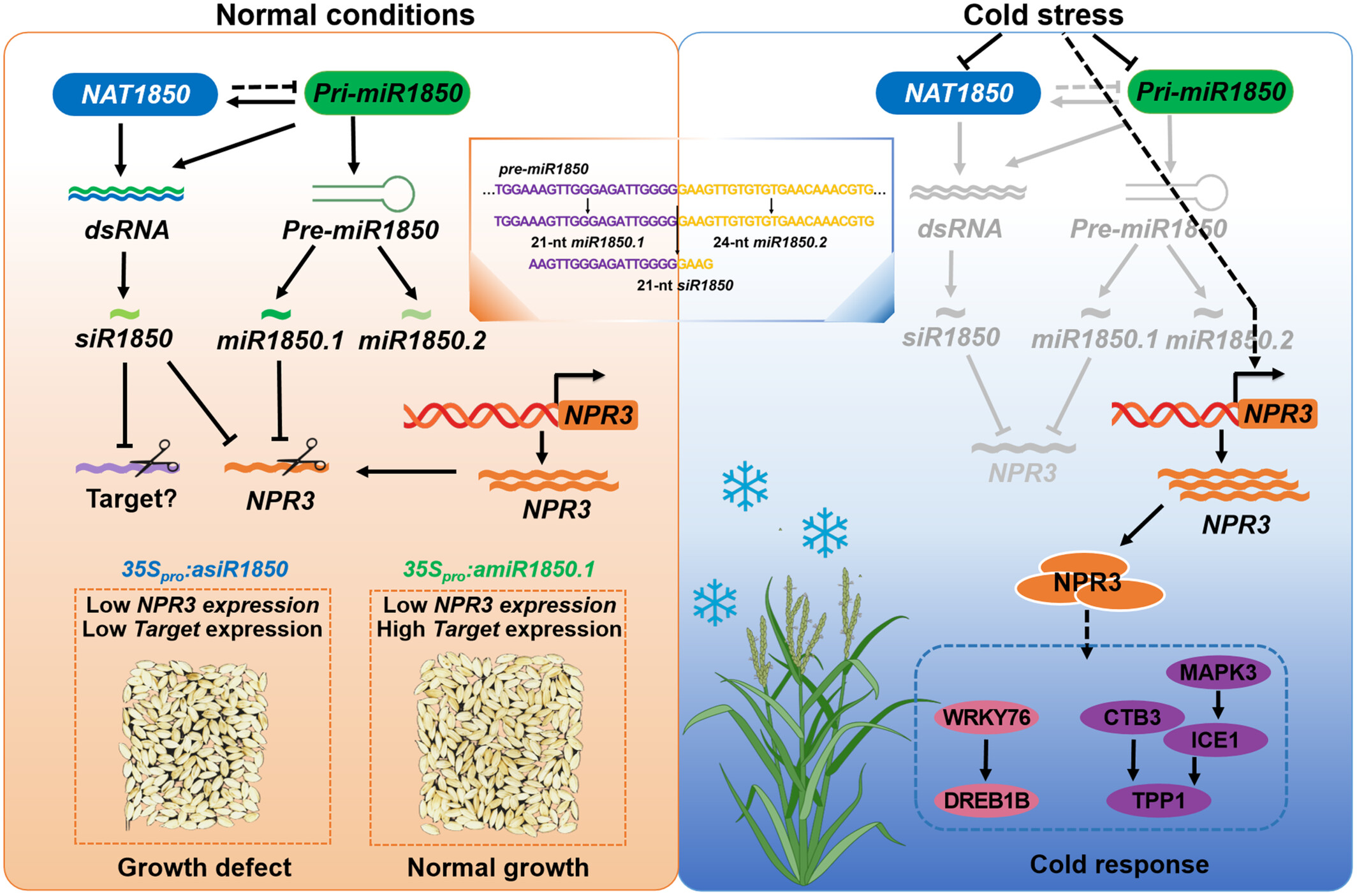
 A working model for the rice pri-miR1850-NAT1850 module in balancing growth and cold response.
The Rice Cis-Natural Antisense Transcript NAT1850 of Pri-miR1850 Negatively Regulates Cold Tolerance by Repressing NPR3
Paper
2026
Plant Biotechnology Journal |
DOI
Background
Natural antisense transcripts (NATs) represent a large fraction of rice loci, yet their functions remain largely unexplored. This study characterizes a rice cis-NAT (NAT1850) that fully overlaps the primary miRNA pri-miR1850. Pri-miR1850 promotes NAT1850 accumulation, while NAT1850 represses pri-miR1850. The resulting double-stranded RNA produces a 21-nt siRNA, siR1850, which targets NPR3, a co-activator of WRKY76 that triggers DREB1B under cold stress. Both NAT1850 and siR1850 negatively regulate cold tolerance at seedling and booting stages, while also influencing nitrogen assimilation and yield through a distinct pathway, revealing a regulatory module balancing cold response and growth.
Key Findings
The rice cis-natural antisense transcript NAT1850 completely overlaps pri-miR1850 and forms a dsRNA that generates the siRNA siR1850. Pri-miR1850 promotes NAT1850 accumulation, whereas NAT1850 represses pri-miR1850 transcripts. siR1850, sharing 17 nt with miR1850.1, targets and represses NPR3, which interacts with WRKY76 and acts as a co-transcriptional activator to induce DREB1B under cold stress. Overexpression of NAT1850 or siR1850 reduces cold tolerance at both seedling and booting stages in an NPR3-dependent manner. Additionally, the NAT1850-siR1850 module regulates nitrogen assimilation and rice yield independently of miR1850.1-NPR3, highlighting a regulatory pathway that balances cold-stress tolerance and yield.
Contribution
Creative Biogene provided the pCAMBIA3301 vector used for overexpression and related constructs, supporting the generation of transgenic rice lines in this study.