

 The Kinetic Selectivity of PU-H71 Enables Real-Time Epichaperome Engagement Monitoring by PU-PET in Individual Patients' Tumors, at the Single-Lesion Resolution
Paradigms for Precision Medicine in Epichaperome Cancer Therapy
Paper
2019
Cancer Cell |
DOI
Background
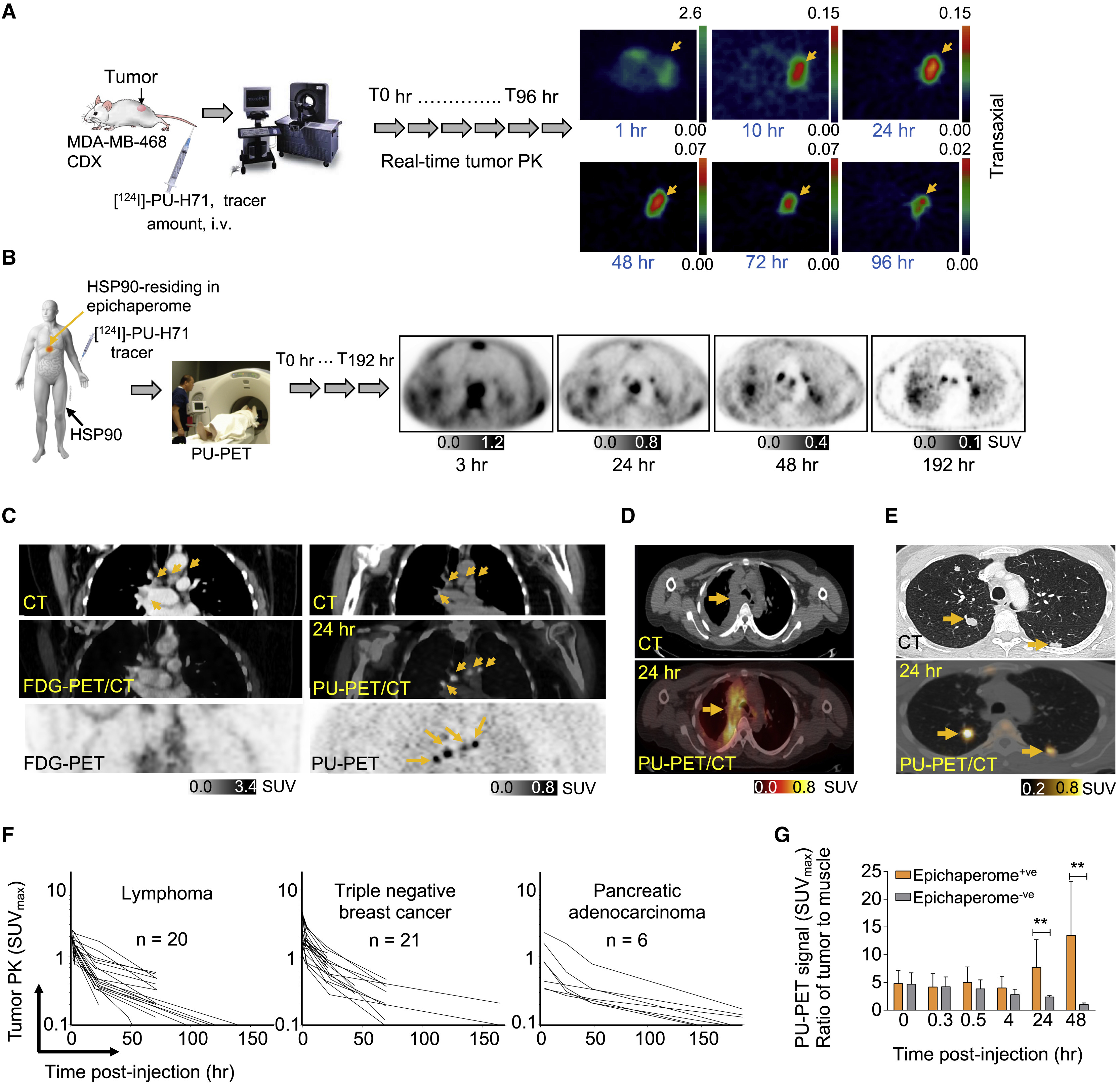
This study establishes a precision-medicine paradigm using [124I]PU-H71 PET to visualize and quantify the epichaperome, a pathologic protein–protein interaction network in cancer. Exploiting PU-H71’s kinetic selectivity, the authors monitor real-time inhibitor engagement in individual tumors, derive tumor pharmacokinetics non-invasively, and optimize dose and schedule. Preclinical and clinical data show that intratumoral concentrations ≥5 µM at 24 h indicate complete target engagement, and epichaperome-positive patients can benefit from PU-H71, supporting a theranostic approach for precision oncology.
Key Findings
PU-PET with [124I]PU-H71 visualized epichaperome networks and their inhibitor engagement in mice and patients at single-lesion resolution in real time. In MDA-MB-468 tumors, target occupancy neared maximum at 25–50 mg/kg and saturated at ~75 mg/kg; a 5 µM intratumoral concentration at 24 h indicated complete target engagement. In a phase 1 trial, PU-H71 doses of 180–300 mg/m² achieved target-engaging tumor concentrations, while plasma PK did not correlate with tumor PK. PU-PET-derived tumor PK curves were validated and used to simulate dosing schedules; target occupancy correlated with antitumor efficacy, and 75 mg/kg produced cures in high-epichaperome models. Preliminary clinical experiences showed prolonged disease control in epichaperome-positive metastatic breast cancer and complete remission in MPN-transformed AML.
Contribution
Creative Biogene provided the luciferase/GFP reporter NCI-H1975 human lung cancer cell line (Cat# CSC-RR0209), which the authors used to establish a second high-epichaperome xenograft model for evaluating PU-H71 efficacy and target engagement. This reagent supported preclinical validation of the epichaperome-targeting therapeutic paradigm.