Transfected Stable Cell Lines
Reliable | High-Performance | Wide Rage
Precision reporter, kinase, immune receptor, biosimilar, Cas9, and knockout stable cell lines for diverse applications.


Cat. No. : CSC-RT2661
Target Gene : PIEZO1 Host Cell : HEK293T
Size : >1x10⁶ cells/vial Validation : Sequencing
| Cat. No. | CSC-RT2661 |
| Description | This cell is a stable cell line with a homozygous knockout of human PIEZO1 using CRISPR/Cas9. |
| Target Gene | PIEZO1 |
| Host Cell | HEK293T |
| Host Cell Species | Homo sapiens (Human) |
| Size | 1 vial (10^6 cell/vial) |
| Validation | Sequencing |
| Storage | Liquid nirtogen |
| Shipping | Dry ice package |
| Revival | Rapidly thaw cells in a 37°C water bath. Transfer contents into a tube containing pre-warmed media. Centrifuge cells and seed into a 25 cm2 flask containing pre-warmed media. |
| Media Type | Cells were cultured in DMEM supplemented with 10% fetal bovine serum. |
| Growth Properties | Cells are cultured as a monolayer at 37°C in a humidified atmosphere with 5% CO2. Split at 80-90% confluence, approximately 1:3-1:6. |
| Freeze Medium | Complete medium supplemented with 10% (v/v) DMSO |
| Mycoplasma | Negative |
| Format | One frozen vial containing millions of cells |
| Storage | Liquid nitrogen |
| Safety Considerations |
The following safety precautions should be observed. 1. Use pipette aids to prevent ingestion and keep aerosols down to a minimum. 2. No eating, drinking or smoking while handling the stable line. 3. Wash hands after handling the stable line and before leaving the lab. 4. Decontaminate work surface with disinfectant or 70% ethanol before and after working with stable cells. 5. All waste should be considered hazardous. 6. Dispose of all liquid waste after each experiment and treat with bleach. |
| Ship | Dry ice |
| Gene Name | PIEZO1 piezo-type mechanosensitive ion channel component 1 [ Homo sapiens ] |
| Gene Symbol | PIEZO1 |
| Synonyms | Mib; FAM38A |
| GeneID | 9780 |
| Uni ProtID | Q92508 |
| mRNA Refseq | BC008073 |
| Chromosome Location | 16q24.3 |
| Function | cation channel activity; |
| MIM | 611184 |
PIEZO1 (piezo-type mechanosensitive ion channel component 1) is a mechanosensitive ion channel protein that plays a vital role in a variety of physiological processes in the human body. PIEZO1 has a unique structure that contains a large number of transmembrane domains, which enable it to form a complex ion channel pore. This ion channel is sensitive to mechanical changes in the cellular environment, such as pressure, stretch, or shear stress, allowing it to mediate the influx of cations, including calcium ions, when activated. This ion flow is essential for triggering intracellular signaling pathways that can affect cell shape, movement, and function.
One of the most studied roles of PIEZO1 in red blood cells is that it helps maintain the volume and shape of red blood cells by sensing mechanical stress as they circulate in narrow capillaries. In addition, PIEZO1 is also involved in vascular biology, where it affects blood flow and vascular tone. Vascular endothelial cells use PIEZO1 to sense and respond to shear stress generated by blood flow, which is essential for vascular development and function. Mutations in the PIEZO1 gene are associated with diseases such as hereditary erythrocytosis dryii, a disease characterized by dehydration of red blood cells, which leads to hemolytic anemia.
Mechanosensitive channels are integral membrane proteins that sense mechanical stimuli. Like most plasma membrane ion channel proteins, they must undergo biogenesis quality control in the endoplasmic reticulum before reaching their destination at the plasma membrane. Studies here demonstrate that N-linked glycosylation of two highly conserved asparagine residues in the 'cap' region of the mechanosensitive Piezo1 channel is essential for the mature protein to reach the plasma membrane. Both mutation of these asparagines (N2294Q/N2331Q) and treatment with an enzyme that hydrolyzes N-linked oligosaccharides (PNGaseF) abolished the fully glycosylated mature Piezo1 protein. N-glycans in the cap are a prerequisite for N-glycosylation of the 'propeller' region, which is present in a loop essential for mechanotransduction. Importantly, trafficking-defective Piezo1 variants associated with systemic lymphoid dysplasia and bicuspid aortic valves showed reduced fully N-glycosylated Piezo1 protein. Thus, in vitro N-linked glycosylation status correlates with efficient membrane trafficking and will help determine the functional impact of Piezo1 variants of unknown significance.
In this study, negative pressure was applied to cell-attached patches of transiently transfected Piezo1 knockout HEK293T cells using a high-speed pressure clamp. Both single mutants exhibited normal stretch-activated responses (Figure 1a, b), consistent with the two bands on the western blot. Given the strong evidence that the cap is involved in Piezo1 inactivation, the researchers tested whether inactivation was altered, but neither Asn to Gln mutant affected the inactivation time constant in the cell-attached patch (Figure 1c). However, the N2294Q/N2331Q mutant had almost no stretch-activated current (Figure 1a, b), indicating that the FG Piezo1 protein represents a pool of membrane proteins.
In addition, the researchers confirmed the trafficking defect using a combination of nanogold immunolabeling and transmission electron microscopy (TEM) with Piezo1 knockout HEK293T cells. Micrographs clearly showed that WT Piezo1 had reached the plasma membrane, whereas the N2294Q/N2331Q double mutant had little or no membrane labeling (Figure 1d). Quantification of the ratio of membrane to intracellular nanogold staining for Piezo1 and N2294Q/N2331Q showed a significant reduction in membrane labeling for N2294Q/N2331Q, consistent with a trafficking defect (Figure 1e). Nano-gold labelling was not seen in un-transfected Piezo1 knockout HEK293T cells.
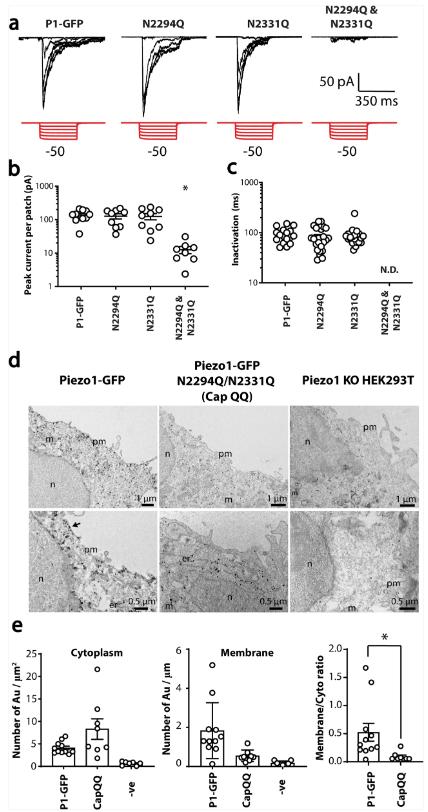 Figure 1. Effect of mutation of N2294 and N2331 on mechanically induced gating of Piezo1. (Li J V, et al., 2021)
Applications of Human PIEZO1 Knockout Cell Line-HEK293T:
Mechanotransduction Studies: The PIEZO1 knockout in HEK293T cells allows researchers to study the role of PIEZO1 in mechanotransduction processes. By comparing knockout and wild-type cells, insights into how mechanical stimuli are converted into biological signals can be obtained.
Drug Screening: These cells are useful for screening potential therapeutic compounds targeting the PIEZO1 pathway. Knockout cells can serve to identify specific actions and side effects of drugs that modulate mechanosensitive channels.
Pathophysiological Research: PIEZO1 plays a role in various diseases such as hypertension, anemia, and cancer. Using PIEZO1 knockout HEK293T cells helps in understanding how the lack of this gene affects cellular processes and contributes to these disease states.
Genetic and Cellular Biomechanics: Researchers can use these cells to study the genetic and cellular mechanisms underlying biophysical properties of cells. This helps in exploring the impact of PIEZO1 on cellular stiffness, morphology, and motility.
Ion Channel Functionality: Detailed studies on the functionality of ion channels can be conducted using PIEZO1 knockout cells. This includes examining the effects on ion flux, membrane potential, and cellular homeostasis.
A: DMEM supplemented with 10% fetal bovine serum. <br> It is not required to add the selection antibiotics when culturing the KO cells.
A: The knockout cell product is validated by PCR amplification and Sanger Sequencing to confirm the mutation at the genomic level. Please find the detailed mutation info in the datasheet.
A: Single clonal cell.
A: No. This knockout cell product is generated using the CRISPR/Cas9 system to induce small insertions or deletions (indels) resulting in frameshift mutations. Although these frameshift mutations typically disrupt the coding gene, there is a possibility that the non-functional transcript may still be transcribed. Consequently, this could potentially yield misleading results when analyzed by RT-qPCR.
A: The cell line should be stored in liquid nitrogen for long-term preservation.
A: For most cases, we often keep at least 2 clones with different frameshift mutations. Please feel free to contact us to check if there are additional available clones.
If your question is not addressed through these resources, you can fill out the online form below and we will answer your question as soon as possible.
The Human PIEZO1 Knockout Cell Line-HEK293T is highly versatile, fitting seamlessly into a wide array of experimental setups. We've used it for gene expression studies, electrophysiological assays, and drug screening, and it performs excellently across all these applications.
The technical support team behind the Human PIEZO1 Knockout Cell Line-HEK293T is phenomenal. They were prompt in addressing our queries and guided us through the initial setup and troubleshooting processes.
Write a review of your use of Biogene products and services in your research. Your review can help your fellow researchers make informed purchasing decisions.
Copyright © 2026 Creative Biogene. All rights reserved.