

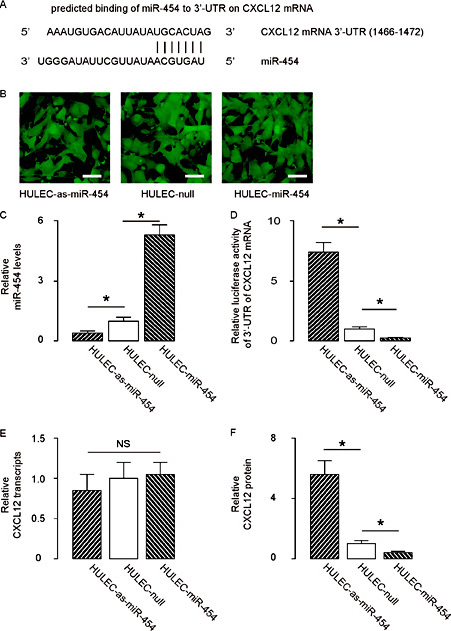
 MiR-454 targets the 3'-UTR of CXCL12 mRNA to inhibit its protein translation in human lung epithelial cells.
Alleviation of Lipopolysaccharides-Induced Acute Lung Injury by MiR-454
Paper
2016
Cellular Physiology and Biochemistry |
DOI
Background
This study explores whether microRNA-based therapy can suppress acute lung injury (ALI)-associated inflammation. Bioinformatics analysis and luciferase reporter assays identified miR-454 as a unique miRNA targeting the 3'-UTR of CXCL12 mRNA (bases 1466-1472), inhibiting its protein translation in human lung epithelial cells without altering mRNA levels. Using adeno-associated virus (AAV) to overexpress miR-454 in mouse lung, the authors demonstrate reduced LPS-induced vascular permeability, attenuated histological damage, and decreased inflammatory cytokine production, suggesting miR-454 as a promising therapeutic target for ALI.
Key Findings
MiR-454 was identified as the only miRNA targeting the 3'-UTR of CXCL12 mRNA, binding at the 1466th-1472nd base site in human lung epithelial (HULEC) cells; luciferase reporter assays confirmed functional binding, and miR-454 modulation reduced CXCL12 protein but not mRNA, indicating translational inhibition. In vivo, AAV-mediated overexpression of miR-454 in mouse lung significantly reduced LPS-induced increases in the permeability index and attenuated histological features of ALI, including neutrophil/fibrin deposits and intra-alveolar hemorrhage. Levels of inflammatory cytokines CXCL1, CXCL2, IL6, and TNFα in bronchoalveolar lavage fluid were markedly reduced. Flow cytometry showed decreased CD45+ inflammatory cell recruitment, consistent with suppression of the CXCL12/CXCR4 axis. These data suggest miR-454 overexpression may be a promising therapeutic strategy to reduce ALI severity.
Contribution
Creative Biogene provided the target sequence clone for the CXCL12 miRNA 3'-UTR, which was used to construct the luciferase reporter plasmids. This reagent enabled the functional validation of miR-454 binding to the CXCL12 3'-UTR, a key step confirming that miR-454 directly and specifically targets CXCL12 mRNA.