


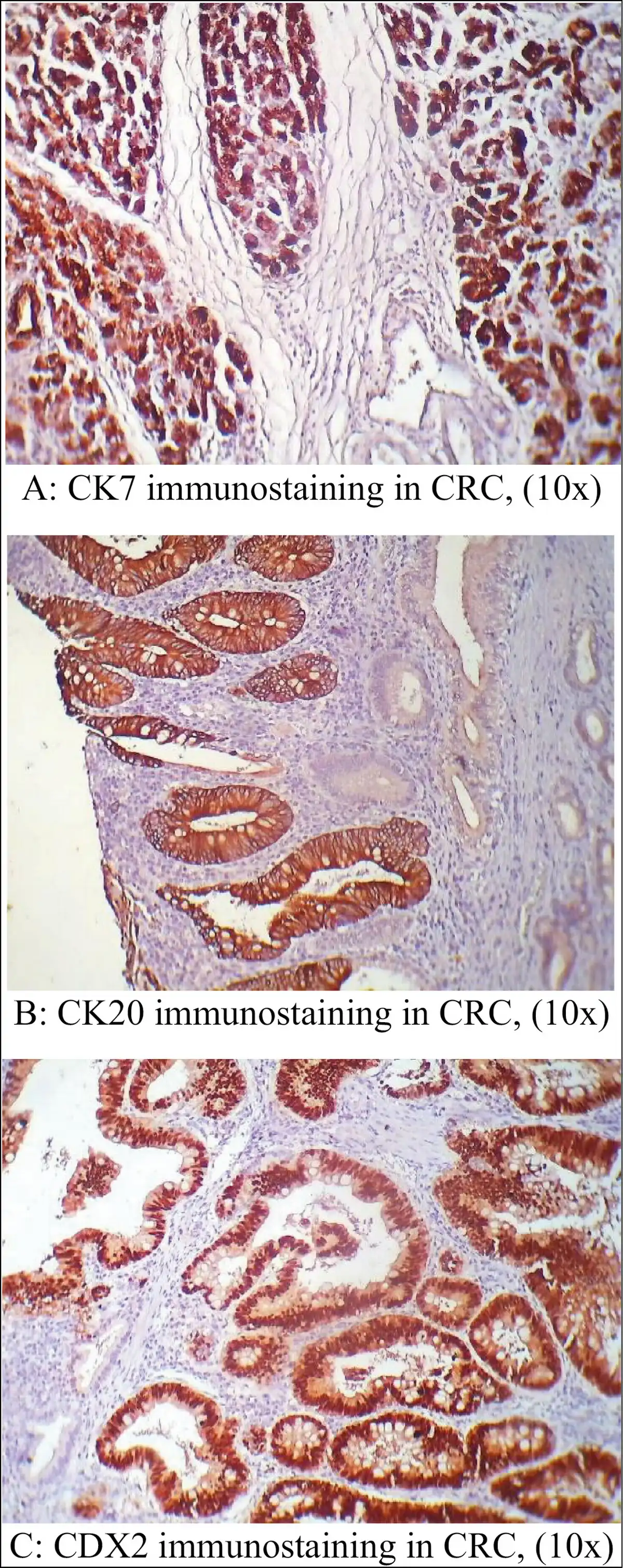
 Photomicrographs (A, B, C) of studied colonic markers expression in CRC (10x).
Investigate the Relationship Between the Presence of JCV DNA and the Immunohistochemical Expression of CK2 0, CK7, and CDX2 in Colorectal Cancer
Paper
2024
Medical Journal of Babylon |
DOI
Background
Colorectal cancer (CRC) is a leading malignancy with high mortality. This study investigated the presence of JC virus (JCV) DNA and its association with the immunohistochemical expression of CK7, CK20, and CDX2 in 90 CRC specimens (45 adenocarcinomas, 45 squamous cell carcinomas). JCV DNA was detected via real-time PCR, and immunostaining was performed for tumor markers. Significant correlations were found between JCV presence, tumor stage/age, and marker expression. Results suggest JCV may contribute to CRC development, with CDX2 serving as a sensitive and specific marker for intestinal adenocarcinomas.
Key Findings
JCV DNA was present in 46 (51.1%) of CRC patients, including 22 adenocarcinomas and 24 squamous cell carcinomas, with statistically significant differences (P=0.004). JCV positivity correlated significantly with tumor stage (P=0.04) and age group (P=0.05). Among tumor markers, CK7 expression was detected in 45 (50%) of cases, CK20 in 67 (74.4%), and CDX2 in 21 (23.3%). The presence of JCV DNA was significantly associated with all three markers (P<0.05): 18 (20%) JCV-positive among CK7-positive cases (P=0.03), 30 (33.3%) among CK20-positive (P=0.04), and 15 (16.7%) among CDX2-positive (P<0.05). Loss of CDX2 expression occurred in 76.7% of tumors, linked to histologic type. The study indicates JCV may be involved in CRC pathogenesis and that CDX2 is a valuable diagnostic marker for intestinal adenocarcinomas.
Contribution
Creative Biogene supplied the JC polyomavirus detection kit (Cat. No. PDPS-AR165) used for real-time PCR detection of JCV DNA in colorectal cancer samples.