


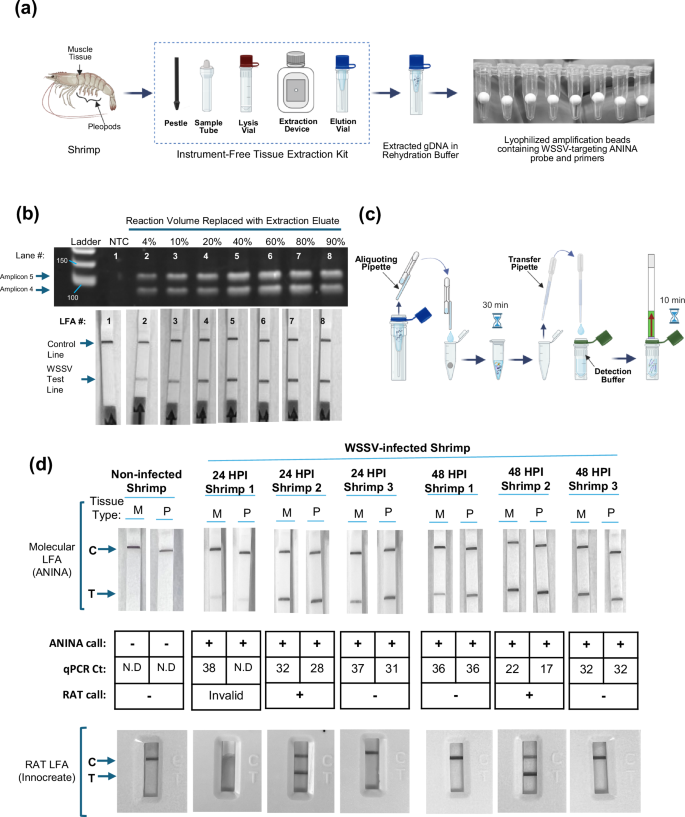
 Instrument-free ANINA detection in a natural host model.
Annexing isothermal nucleotide amplification enables probe-guided amplification and direct detection at ambient temperature
Paper
2026
Nature Communications |
DOI
Background
Isothermal nucleic acid amplification offers decentralized diagnostic advantages but is limited by rigid primer design and detection complexity. Here authors introduce Annexing Isothermal Nucleotide Amplification (ANINA), a probe-guided recombinase-based framework that integrates amplification and direct detection at ambient temperature in one lyophilized reaction. An Annexing Probe spatially recruits short primers, enabling amplification at 25°C within 30 minutes and direct lateral flow readout without auxiliary enzyme processing. ANINA detects attomolar pathogen DNA in host background, supports DNA/RNA viruses and bacteria, and enables a 45-minute, equipment-free workflow with qPCR-level sensitivity in a natural infection model.
Key Findings
ANINA enables efficient isothermal amplification at 25°C within 30 min using primer lengths as short as 10 nt (probe-adjacent primer) and 15 nt (downstream primer), expanding design flexibility beyond conventional recombinase-based methods. The Annexing Probe remains associated with amplicons, permitting direct lateral flow detection without probe cleavage or auxiliary enzyme processing, and supports multiplexed endpoint readout. Assays detect attomolar WSSV and EBV DNA in abundant host genomic background and specifically identify DNA and RNA viruses and bacteria in contrived human matrices. A real-time qANINA format provides log-linear quantification from 1 to 10^6 EBV copies, detecting single-copy input faster than rapid qPCR. Finally, a fully equipment-free 45-min sample-to-answer workflow detects early WSSV infection in naturally infected shrimp with sensitivity comparable to qPCR and improved performance over a commercial antigen test.
Contribution
Creative Biogene's commercial WSSV qPCR kit was used as a reference standard to verify qPCR assay performance for viral quantification, supporting reliability of the diagnostic validation.