


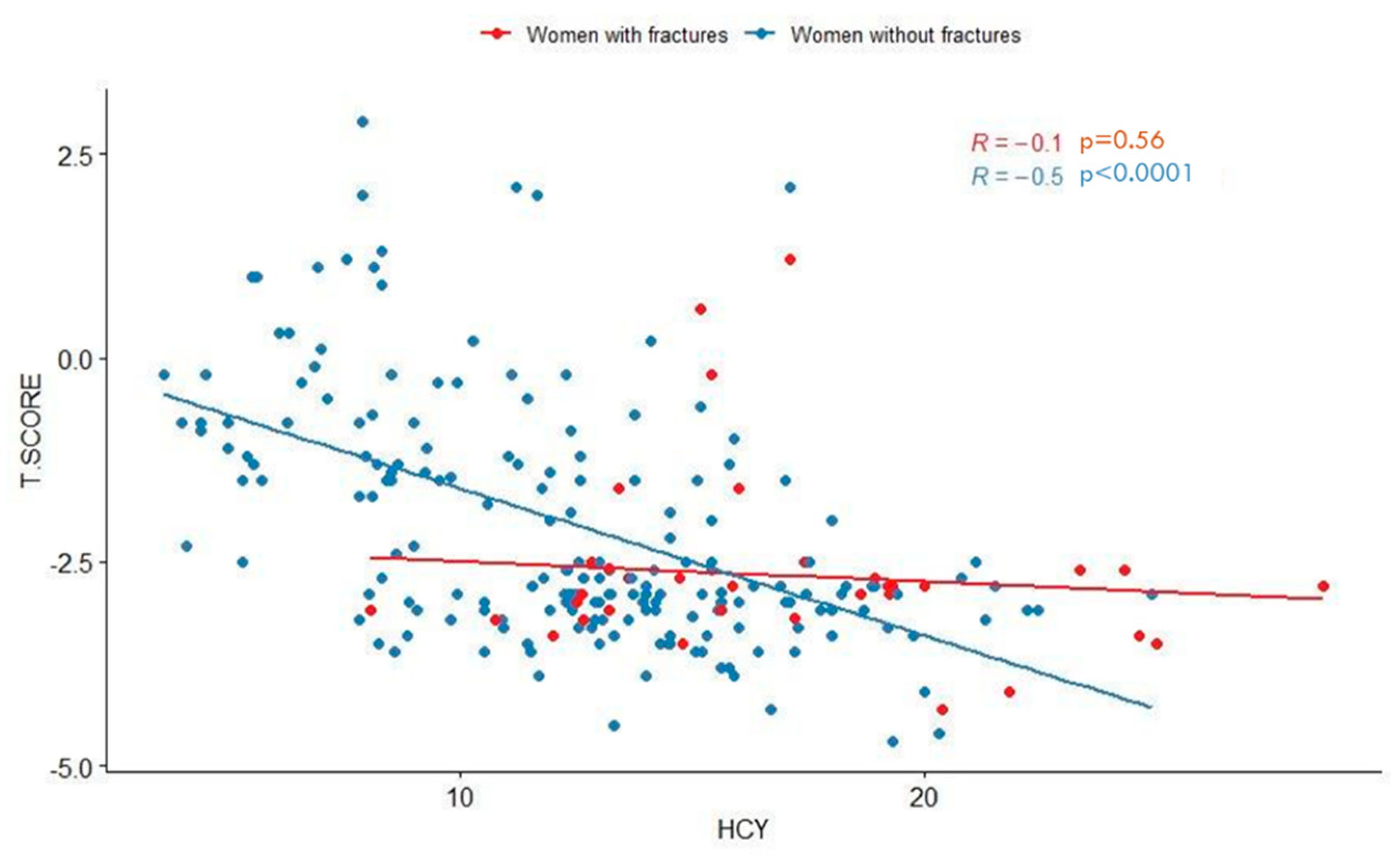
 Scatter plot showing significant negative correlation between homocysteine (Hcy) levels and BMD (T-score values) in postmenopausal women.
Hyperhomocysteinemia is Associated with Inflammation, Bone Resorption, Vitamin B12 and Folate Deficiency and MTHFR C677T Polymorphism in Postmenopausal Women with Decreased Bone Mineral Density
Paper
2020
International Journal of Environmental Research and Public Health |
DOI
Background
This study investigated the relationship between hyperhomocysteinemia and postmenopausal osteoporosis. In 252 postmenopausal women, bone mineral density was measured by DXA, along with serum homocysteine, inflammatory markers, bone turnover markers, vitamin D/B12/folate, and MTHFR C677T polymorphism. Women with decreased BMD had higher homocysteine, inflammation, bone resorption, and MTHFR mutation prevalence, but lower vitamin levels and bone formation markers. The findings suggest homocysteine and inflammation contribute to postmenopausal bone loss and may offer therapeutic targets.
Key Findings
In 252 postmenopausal women, those with low bone mineral density (BMD) showed significantly higher serum homocysteine, erythrocyte sedimentation rate, C-reactive protein, and C-terminal telopeptide of type I collagen (CTX) than women with normal BMD. They also had lower vitamin D, vitamin B12, folate, osteocalcin, and bone-specific alkaline phosphatase. The MTHFR C677T polymorphism was more prevalent in women with decreased BMD (47% overall; 18% homozygous among carriers). Women with homocysteine >12 µmol/L had lower T-scores, higher inflammation and bone resorption, and greater MTHFR mutation prevalence. A significant negative correlation existed between homocysteine levels and BMD T-scores in the total cohort (R = −0.51; p < 0.0001), although not in fractured patients alone. The study supports an association between hyperhomocysteinemia, inflammation, vitamin deficiencies, and increased bone resorption in postmenopausal osteoporosis.
Contribution
Creative Biogene provided the MTHFR C677T Mutation Real Time PCR Kit used to detect the MTHFR gene C677T polymorphism in whole blood samples. This kit enabled specific amplification and real-time fluorescence detection, supporting the genetic analysis central to the study's findings on hyperhomocysteinemia and bone mineral density.