


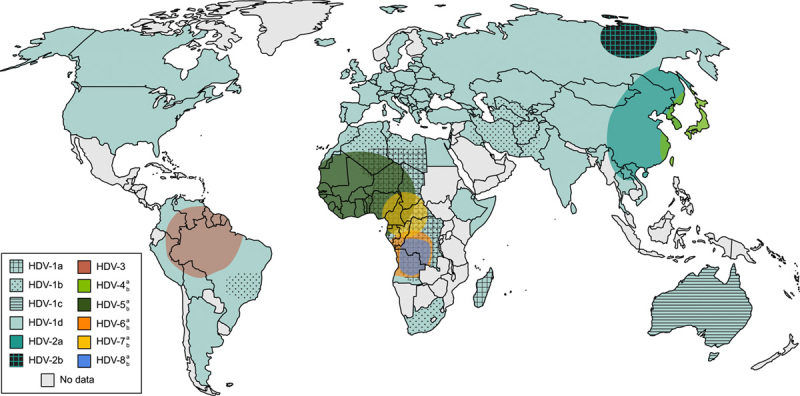
 Worldwide distribution of HDV genotypes and subgenotypes.
HDV RNA assays: Performance characteristics, clinical utility, and challenges
Paper
2023
Hepatology |
DOI
Background
This review examines nucleic acid assays for hepatitis D virus (HDV) RNA, which are essential for diagnosing chronic hepatitis D and monitoring antiviral treatment response. It discusses how HDV genetic diversity (eight genotypes), intrahost variation, RNA secondary structure, extraction methods, primer/probe design, and lack of standardization cause assay variability. The World Health Organization standard aids comparison. The authors summarize commercial and laboratory-developed assays, performance characteristics, and provide recommendations for drug development and patient monitoring. It also highlights the importance of standardized, reliable quantification for clinical trials and patient care.
Key Findings
Reliable, standardized HDV RNA quantification is critical for diagnosing chronic hepatitis D and monitoring response to new antivirals, but assay performance varies widely. HDV's eight genotypes, subgenotypes, intrahost diversity, rapid evolution, and highly structured RNA genome complicate primer/probe design and RNA extraction. Many commercial and laboratory-developed tests underestimate viral load, especially for African genotypes. The WHO HDV RNA international standard supports calibration and comparison, yet extraction methods, automation, internal controls, and target regions influence sensitivity and accuracy. The review recommends assays calibrated to the WHO standard, incorporating an internal control throughout extraction and amplification, covering all eight HDV genotypes with similar sensitivity, using conserved ribozyme or delta antigen targets, and reporting results in IU/mL with consistent terminology. Such assays are essential for drug development and patient monitoring.
Contribution
Creative Biogene is included in Table 2 as a commercial kit provider for its HDV Real-time RT-PCR Kit. The review does not report original data or validation from Creative Biogene; it lists the kit among available HDV RNA assays and notes that calibration to the WHO international standard is unknown.